How to Become a Physiotherapist: Education, Skills, Salary, and Career Path
Published: 15 Nov 2026
Choosing a healthcare career can be rewarding, especially if you enjoy helping people improve their health and quality of life. Physiotherapy is an important healthcare profession that helps people recover from injuries, manage pain, improve movement, and regain strength. Physiotherapists work with patients of different ages and backgrounds, supporting them throughout their recovery journeys.
If you are interested in human anatomy, physical health, rehabilitation, and patient care, becoming a physiotherapist could be an excellent career choice. This profession offers opportunities to work in hospitals, private clinics, rehabilitation centers, sports facilities, and other healthcare settings.
However, becoming a physiotherapist requires proper education, clinical training, practical experience, and professional registration or licensing, depending on your country.
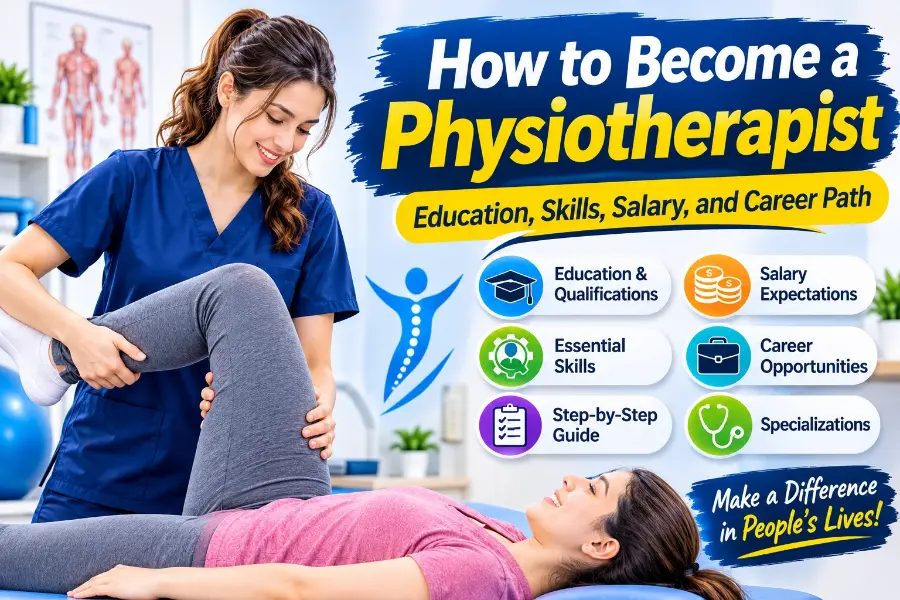
In this guide, you will learn how to become a physiotherapist, what education and qualifications you need, which skills are important, how much physiotherapists earn, and what career opportunities are available in this field.
What Is a Physiotherapist?
A physiotherapist is a healthcare professional who helps people improve their physical movement, strength, balance, and overall mobility. They assess patients’ physical conditions and develop treatment plans to help them recover from injuries, illnesses, surgeries, and other health problems.
Physiotherapists use different treatment methods, including therapeutic exercises, movement training, manual therapy, and rehabilitation techniques. Their main goal is to reduce physical limitations and help patients become more independent in their daily activities.
For example, someone recovering from a sports injury may visit a physiotherapist to rebuild muscle strength and return to physical activities. Similarly, a person recovering from surgery may need physiotherapy to improve movement and regain normal physical function.
Physiotherapists work with children, adults, older people, athletes, and individuals with long-term physical conditions. They play an important role in healthcare by helping patients maintain mobility, prevent further injuries, and improve their quality of life.
What Does a Physiotherapist Do?
Physiotherapists perform several responsibilities depending on their workplace, specialization, and patients’ needs. Their daily work focuses on assessing physical conditions, providing treatment, and helping patients achieve their recovery goals.
Here are some of the main responsibilities of a physiotherapist.
Assess Patients’ Physical Conditions
One of a physiotherapist’s first responsibilities is to understand a patient’s physical condition. They examine movement, muscle strength, flexibility, balance, posture, and physical limitations.
They may also review medical history and discuss symptoms with patients to understand their health concerns. These assessments help physiotherapists identify problems and choose suitable treatment methods.
Develop Personalized Treatment Plans
Because every patient has different physical needs, physiotherapists create treatment plans based on individual conditions and recovery goals.
These plans may include:
- Therapeutic exercises to improve muscle strength and flexibility.
- Movement training to restore normal physical function.
- Manual therapy to improve movement and reduce discomfort.
- Balance exercises to improve stability and coordination.
- Rehabilitation activities to support recovery after injuries or surgeries.
Personalized treatment plans help patients make progress safely and effectively.
Help Patients Recover from Injuries
Physiotherapists help patients recover from various physical injuries, including muscle strains, joint problems, sports injuries, and fractures.
They guide patients through suitable rehabilitation exercises and monitor their progress during recovery. Their support can help patients regain strength, improve movement, and return to their regular activities.
Improve Mobility and Physical Strength
Some patients experience difficulty walking, standing, lifting objects, or performing everyday activities because of injuries, illnesses, or age-related physical changes.
Physiotherapists use exercises and movement techniques to improve their strength, flexibility, balance, and coordination. Their goal is to help patients move more comfortably and independently.
Educate Patients About Injury Prevention
Another important responsibility is teaching patients how to protect their bodies and avoid future injuries.
Physiotherapists may advise on proper posture, safe exercise techniques, workplace ergonomics, and healthy movement habits. This education helps patients maintain their physical health.
Monitor Patient Progress
Physiotherapists regularly check how patients respond to treatment. They measure improvements in movement, strength, flexibility, and physical performance.
If a treatment plan is not producing the expected results, they may adjust exercises or recommend different rehabilitation approaches. Monitoring progress helps ensure that patients receive appropriate care throughout their recovery.
How to Become a Physiotherapist – 8 Steps Career Guide
Becoming a physiotherapist requires several important steps, from completing your school education to gaining professional experience. Although specific requirements vary between countries, the general career pathway is similar in many places.
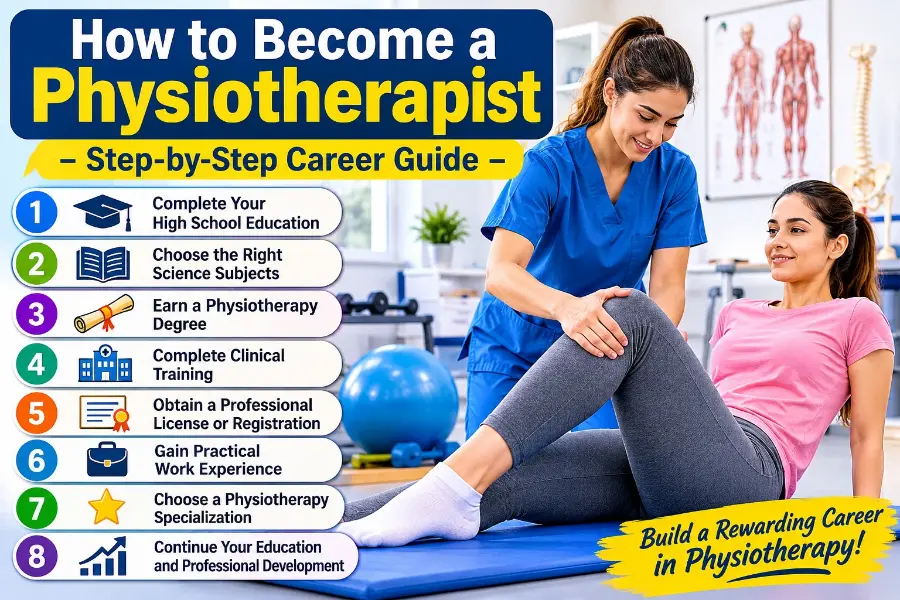
Here are eight important steps to help you start your career in physiotherapy.
Step 1: Complete Your High School Education
The first step is to complete high school with strong academic results. Students interested in physiotherapy should focus on science subjects because they provide the foundation for understanding the human body and healthcare.
Useful subjects include:
- Biology: Helps you understand the human body, organs, muscles, and body systems.
- Chemistry: Provides basic knowledge of chemical processes in the body.
- Physics: Helps explain movement, force, balance, and physical mechanics.
- Mathematics: Develops problem-solving and analytical skills.
Strong knowledge of science subjects can make it easier to understand advanced physiotherapy topics during university studies.
Step 2: Choose the Right Science Subjects
After completing basic education, choose an academic pathway that meets the admission requirements of physiotherapy programs in your country.
Many universities prefer students with a science background, particularly biology. Some institutions may also require specific grades, entrance examinations, or other admission qualifications.
Before applying, research different universities and check their physiotherapy admission requirements.
Choosing the right subjects early can help you prepare for professional studies and improve your chances of entering a suitable degree program.
Step 3: Earn a Physiotherapy Degree
Next, complete an accredited physiotherapy education program. This is one of the most important requirements for entering the profession.
Depending on your country, you may pursue a bachelor’s degree in physiotherapy, a Doctor of Physical Therapy (DPT), or another recognized professional qualification.
During your studies, you will learn important subjects such as:
- Human Anatomy: Understanding the structure of the human body.
- Physiology: Learning how different body systems function.
- Biomechanics: Understanding body movement and physical forces.
- Pathology: Studying diseases and health conditions.
- Exercise Therapy: Learning how therapeutic exercises support recovery.
- Neurology: Understanding the nervous system and related conditions.
- Orthopedics: Studying bones, muscles, joints, and movement disorders.
- Rehabilitation: Learning methods for restoring physical function.
These subjects prepare students to assess patients, understand physical conditions, and provide appropriate rehabilitation services.
Step 4: Complete Clinical Training
Classroom education matters, but practical experience is equally necessary to become a competent physiotherapist.
Most recognized physiotherapy programs include supervised clinical placements or practical training. During this stage, students work in healthcare environments and observe experienced professionals.
Clinical training may involve:
- Observing patient assessments and treatment sessions.
- Practicing basic rehabilitation techniques under supervision.
- Learning how to communicate with patients.
- Understanding clinical documentation and patient records.
- Developing professional behavior and teamwork skills.
- Applying classroom knowledge to real healthcare situations.
This experience helps students build confidence and understand the responsibilities of working with patients.
Step 5: Obtain a Professional License or Registration
After completing your degree and required clinical training, you may need to obtain professional registration or a license before practicing independently.
The requirements depend on the country where you want to work. Some countries require licensing examinations, registration with a professional regulatory body, supervised practice, or additional assessments.
For example, physiotherapists in the United States generally need to meet state licensing requirements, while professionals in the United Kingdom must register with the Health and Care Professions Council (HCPC).
In other countries, different regulatory authorities manage professional registration.
Always check the requirements of the country where you plan to work. Completing a degree alone does not automatically give you permission to practice everywhere.
Step 6: Gain Practical Work Experience
After obtaining the required qualifications and registration, start building professional experience.
You can apply for entry-level positions in hospitals, rehabilitation centers, private clinics, and other healthcare facilities.
Working with experienced physiotherapists helps you build clinical knowledge and learn to manage different patient conditions.
During your early career, focus on:
- Developing strong patient assessment skills.
- Learning different rehabilitation techniques.
- Improving communication with patients and healthcare professionals.
- Understanding treatment planning and progress monitoring.
- Building confidence in clinical decision-making.
Practical experience is essential for developing the skills needed to become a successful physiotherapist.
Step 7: Choose a Physiotherapy Specialization
After gaining some professional experience, you may decide to focus on a particular area of physiotherapy.
Specialization allows you to develop advanced knowledge and work with specific patient groups or health conditions.
Some popular areas include sports physiotherapy, neurological physiotherapy, orthopedic physiotherapy, pediatric physiotherapy, and geriatric physiotherapy.
You can choose a specialization based on your interests, career goals, and available professional training opportunities.
Step 8: Continue Your Education and Professional Development
Healthcare practices and rehabilitation techniques continue to develop. Therefore, physiotherapists need to keep learning throughout their careers.
You can improve your professional knowledge through workshops, advanced courses, professional certifications, conferences, and postgraduate education.
Continuing professional development helps you stay informed about new research, treatment methods, and healthcare standards.
It can also improve your career opportunities and prepare you for advanced clinical or leadership positions.
What Education Is Required to Become a Physiotherapist?
Becoming a physiotherapist requires a recognized professional qualification in physiotherapy or physical therapy. The exact educational pathway depends on the country, university, and professional regulations.
Here are the main educational options.
High School Education Requirements
Students interested in physiotherapy should complete secondary school with relevant science subjects.
Biology is particularly useful because physiotherapy requires an understanding of muscles, bones, joints, nerves, and other body systems.
Chemistry and physics also provide valuable knowledge for studying human physiology and movement.
Universities may have different admission requirements, so check their academic criteria before applying.
Bachelor’s Degree in Physiotherapy
Many countries offer bachelor’s degree programs in physiotherapy or physical therapy.
These programs provide academic knowledge and practical training in human anatomy, physiology, rehabilitation, and patient care.
The duration and structure of bachelor’s programs vary between educational systems. Some programs take three to four years, while others may have different requirements.
Completing an accredited program can provide the foundation needed to pursue professional registration, depending on local regulations.
Doctor of Physical Therapy (DPT)
A Doctor of Physical Therapy (DPT) is a professional degree offered in several countries, including the United States and Pakistan.
In the United States, DPT is generally an entry-level professional degree for people seeking to become licensed physical therapists. Admission usually requires previous undergraduate coursework or a bachelor’s degree, depending on the university.
In Pakistan, the DPT program is commonly structured as a five-year undergraduate professional degree after intermediate education.
The curriculum typically covers anatomy, physiology, biomechanics, clinical sciences, rehabilitation, and supervised clinical practice.
Degree structures and professional recognition differ between countries.
Master’s Degree and Advanced Education
Some physiotherapists choose to pursue a master’s degree after completing their initial professional qualification.
A master’s degree can help professionals develop advanced knowledge in specific areas of physiotherapy.
Possible postgraduate study areas include:
- Sports physiotherapy.
- Neurological rehabilitation.
- Musculoskeletal physiotherapy.
- Pediatric physiotherapy.
- Geriatric rehabilitation.
- Cardiopulmonary physiotherapy.
Advanced education can support career development, research opportunities, teaching positions, and specialized clinical practice.
Important Skills Every Physiotherapist Needs
Education and professional qualifications are essential, but successful physiotherapists also need strong personal and professional skills.
These skills help them communicate with patients, understand physical problems, and provide effective rehabilitation support.
Communication Skills
Physiotherapists work closely with patients, doctors, nurses, and other healthcare professionals. Good communication skills help them explain treatment plans, understand patient concerns, and provide clear instructions.
They should be able to communicate complex medical information in simple language so patients can understand their recovery process.
Problem-Solving Skills
Every patient has different physical conditions and recovery needs. Physiotherapists must analyze problems and identify suitable treatment approaches.
Strong problem-solving skills help them adjust rehabilitation plans when patients have difficulties or don’t respond as expected.
Physical Stamina
Physiotherapists often spend long hours standing, walking, demonstrating exercises, and assisting patients with movement.
Good physical stamina helps them manage these responsibilities throughout the working day.
They should also maintain proper body mechanics to protect themselves from workplace injuries.
Empathy and Compassion
Patients may experience pain, frustration, anxiety, or difficulty during recovery.
Physiotherapists need empathy and patience to understand these challenges and provide emotional support.
A caring attitude can help patients feel comfortable and motivated throughout their rehabilitation journey.
Attention to Detail
Small changes in movement, posture, muscle strength, and physical performance can provide important information about a patient’s condition.
Attention to detail helps physiotherapists conduct accurate assessments and monitor treatment progress.
It also helps them identify potential problems and adjust treatment plans as needed.
Knowledge of Human Anatomy
A strong understanding of human anatomy is essential for physiotherapists.
They need to understand how muscles, bones, joints, nerves, and other body structures work together.
This knowledge helps them assess movement problems and select appropriate rehabilitation techniques.
Patience and Motivation Skills
Physical recovery can take time, and some patients may struggle to complete their rehabilitation exercises.
Physiotherapists must remain patient and encourage individuals to continue working toward their recovery goals.
Their ability to motivate patients can positively affect treatment participation and progress.
Types of Physiotherapy Specializations
Physiotherapy offers several specialization options. Each area focuses on particular health conditions, patient groups, or rehabilitation needs.
Here are some common physiotherapy specializations.
Sports Physiotherapy
Sports physiotherapists work with athletes and physically active individuals who experience sports-related injuries.
They help patients recover from muscle strains, ligament injuries, joint problems, and other physical conditions.
Their responsibilities may include assessing injuries, planning rehabilitation, providing exercise guidance, and educating on injury prevention.
They often work with sports teams, fitness centers, athletic organizations, and private clinics.
Neurological Physiotherapy
Neurological physiotherapy focuses on people with conditions affecting the brain, spinal cord, and nervous system.
These conditions may include stroke, multiple sclerosis, Parkinson’s disease, and spinal cord injuries.
Neurological physiotherapists help patients improve balance, coordination, walking ability, strength, and movement.
Their treatment plans are designed according to each patient’s physical abilities and rehabilitation goals.
Orthopedic Physiotherapy
Orthopedic physiotherapists treat problems involving bones, muscles, joints, ligaments, and other parts of the musculoskeletal system.
They may work with patients recovering from fractures, joint replacement surgery, back pain, arthritis, and sports injuries.
Their goal is to improve movement, reduce physical limitations, and help patients return to daily activities.
Pediatric Physiotherapy
Pediatric physiotherapists work with babies, children, and teenagers who experience developmental or movement-related difficulties.
They may help children with cerebral palsy, developmental delays, muscle weakness, and other physical conditions.
Treatment often includes age-appropriate exercises and activities that support movement, balance, coordination, and physical development.
Geriatric Physiotherapy
Geriatric physiotherapy focuses on improving physical health and mobility among older adults.
As people age, they may experience reduced muscle strength, balance problems, joint stiffness, and difficulties with everyday movement.
Geriatric physiotherapists help older patients maintain independence through suitable exercises, mobility training, and rehabilitation programs.
Cardiopulmonary Physiotherapy
Cardiopulmonary physiotherapists work with patients who have heart and lung conditions.
They help individuals improve breathing, physical endurance, and exercise tolerance through appropriate rehabilitation techniques.
They may work with patients recovering from certain surgeries or managing conditions such as chronic respiratory diseases.
Where Do Physiotherapists Work?
Physiotherapists can work in different healthcare and rehabilitation environments. Their workplace often depends on their specialization, professional experience, and career interests.
Here are some common workplaces for physiotherapists.
Hospitals and Healthcare Centers
Hospitals employ physiotherapists to support patients recovering from surgeries, injuries, illnesses, and other medical conditions.
They may work in different departments, including orthopedic, neurological, intensive care, and rehabilitation units.
Their responsibilities include assessing patients, providing rehabilitation support, and helping individuals regain physical function.
Private Physiotherapy Clinics
Private clinics are popular workplaces for physiotherapists.
They treat patients with back pain, joint problems, sports injuries, muscle weakness, and movement difficulties.
Some experienced physiotherapists also establish their own clinics after meeting the necessary licensing, registration, and business requirements.
Sports Clubs and Fitness Centers
Sports organizations and fitness centers may employ physiotherapists to help athletes prevent injuries and recover from physical problems.
They work with coaches, trainers, and medical professionals to support athletes’ physical performance and recovery.
Sports physiotherapy can be an interesting career path for professionals who enjoy working in athletic environments.
Rehabilitation Centers
Rehabilitation centers provide specialized services for people recovering from serious injuries, surgeries, neurological conditions, or long-term physical problems.
Physiotherapists work with other healthcare professionals to develop rehabilitation programs and help patients improve their independence.
Nursing Homes
Nursing homes and long-term care facilities employ physiotherapists to support older adults and people with mobility difficulties.
They may provide exercises, balance training, walking assistance, and other rehabilitation services.
Their work helps residents maintain physical abilities and perform daily activities more comfortably.
Home Healthcare Services
Some physiotherapists provide treatment in patients’ homes.
Home healthcare services can be useful for individuals who have difficulty traveling to hospitals or clinics because of mobility limitations or other health concerns.
Physiotherapists assess the home environment and provide suitable exercises and rehabilitation support.
How Long Does It Take to Become a Physiotherapist?
The time required to become a physiotherapist depends on your country’s education system and professional requirements.
In some countries, students complete a bachelor’s degree in physiotherapy in about three to four years. In other countries, professional education may involve a longer degree program or additional postgraduate study.
For example, the DPT program in Pakistan commonly takes five years after intermediate education. In the United States, students generally complete undergraduate prerequisites, followed by a DPT program that usually takes around three years.
After completing their education, some graduates may also need additional time for licensing examinations, professional registration, or other regulatory requirements.
Your career timeline may include:
- High school education: Usually completed before entering a university program.
- Professional degree: Commonly takes three to five years, depending on the country and qualification.
- Clinical training: Completed as part of the professional program or through additional supervised requirements.
- Licensing or registration: Depends on your country’s professional regulations.
Therefore, research local university programs and licensing requirements before choosing your educational pathway.
How Much Does a Physiotherapist Earn?
A physiotherapist’s salary depends on several factors, including education, professional experience, specialization, workplace, and geographical location.
Physiotherapists working in large hospitals or specialized healthcare facilities may earn differently from those working in small private clinics.
Similarly, professionals with advanced qualifications and several years of experience may have better earning opportunities than beginners.
Average Physiotherapist Salary
The average salary of a physiotherapist varies significantly between countries.
In developed healthcare markets, physiotherapists may receive competitive salaries because of demand for rehabilitation and physical therapy services.
In other countries, salaries may be lower because of differences in healthcare funding, employment opportunities, and economic conditions.
To understand potential earnings, research current salary information from reliable sources in the country where you want to work.
Entry-Level Physiotherapist Salary
Newly qualified physiotherapists usually begin their careers in entry-level positions.
Their salaries depend on the employer, location, qualifications, and local healthcare market.
Although beginners may earn less than experienced professionals, their income can improve as they develop clinical skills and gain practical experience.
Experienced Physiotherapist Salary
Experienced physiotherapists often have better earning opportunities because they have developed advanced clinical knowledge and practical skills.
Professionals who specialize in areas such as sports rehabilitation, neurological physiotherapy, and orthopedic care may find additional career opportunities.
Senior clinical positions, management responsibilities, teaching, and private practice can also provide different income opportunities.
Factors That Affect Physiotherapist Salaries
Several factors influence how much a physiotherapist earns.
These include:
- Education and qualifications: Advanced degrees and recognized professional certifications may improve career opportunities.
- Work experience: Experienced professionals may qualify for senior positions and higher salaries.
- Specialization: Certain specialized areas may offer different earning opportunities.
- Location: Salaries vary by country, city, and region.
- Workplace: Hospitals, private clinics, sports organizations, and rehabilitation centers may offer different compensation packages.
- Professional reputation: Strong clinical skills and a good professional reputation can help physiotherapists build successful careers.
Understanding these factors can help you make better career decisions and set realistic salary expectations.
Career Opportunities and Job Outlook for Physiotherapists
Physiotherapy offers different career opportunities in healthcare, rehabilitation, sports, education, and private practice.
As populations age and more people seek treatment for injuries, movement difficulties, and long-term physical conditions, the need for rehabilitation services remains important.
Physiotherapists play a valuable role in helping patients recover, maintain physical abilities, and improve their quality of life.
Some career opportunities include:
- Hospital physiotherapist: Providing rehabilitation services to patients in hospital settings.
- Sports physiotherapist: Helping athletes recover from injuries and maintain physical performance.
- Pediatric physiotherapist: Supporting children with movement and developmental difficulties.
- Neurological physiotherapist: Working with patients who have nervous system conditions.
- Orthopedic physiotherapist: Treating musculoskeletal problems and supporting recovery after injuries or surgery.
- Private practice physiotherapist: Providing independent services through a private clinic, where permitted.
- Physiotherapy lecturer: Teaching students at colleges and universities.
- Clinical researcher: Studying rehabilitation methods and contributing to healthcare research.
Physiotherapists can also pursue advanced clinical positions, healthcare management, academic careers, and specialized rehabilitation services.
Overall, this profession provides several pathways for people interested in healthcare and physical rehabilitation. However, actual job opportunities and future demand depend on local healthcare needs, professional regulations, and employment conditions.
Pros and Cons of Becoming a Physiotherapist
Like every profession, physiotherapy has advantages and challenges. Understanding both sides can help you decide whether this career matches your interests and expectations.
Advantages of a Physiotherapy Career
Several reasons explain why people choose physiotherapy as a profession.
- Helping people: You can make a positive difference in patients’ lives by helping them recover and improve their physical abilities.
- Different career options: You can work in hospitals, clinics, sports organizations, rehabilitation centers, and educational institutions.
- Specialization opportunities: You can develop expertise in different areas of physiotherapy.
- Professional development: You can continue learning through advanced courses, certifications, and postgraduate education.
- Personal satisfaction: Watching patients regain movement and independence can be personally rewarding.
- Private practice opportunities: Experienced and appropriately registered professionals may establish their own clinics.
These advantages make physiotherapy an attractive option for people who enjoy healthcare and working directly with patients.
Challenges of Working as a Physiotherapist
Although physiotherapy can be rewarding, it also comes with certain challenges.
- Long working hours: Some physiotherapists work long shifts or manage busy patient schedules.
- Physical demands: The job may require standing for extended periods and helping patients move.
- Emotional challenges: Some patients experience slow recovery, frustration, or long-term physical limitations.
- Continuous education: Physiotherapists need to keep their knowledge and clinical skills up to date.
- Patient management: Working with different personalities and medical conditions requires patience and strong communication.
- Professional responsibilities: Physiotherapists must follow ethical standards, clinical guidelines, and local healthcare regulations.
Understanding these challenges can help you prepare for the responsibilities of this profession.
Is Becoming a Physiotherapist a Good Career Choice?
Becoming a physiotherapist can be a good career choice if you are interested in healthcare, human movement, rehabilitation, and helping people improve their quality of life.
It is particularly suitable for individuals who enjoy science subjects, have good communication skills, and are comfortable working closely with patients.
The profession offers opportunities to work with different age groups and health conditions. You can also choose a specialization, pursue advanced education, or explore private practice as your experience grows.
However, physiotherapy requires dedication, patience, continuous learning, and a willingness to handle physically and emotionally demanding situations.
Before choosing this career, consider your interests, educational goals, local licensing requirements, and available employment opportunities.
If you enjoy helping others and want to build a career in healthcare, physiotherapy may provide a meaningful and rewarding professional journey.
Tips for Building a Successful Career as a Physiotherapist
Earning a physiotherapy degree is an important achievement, but building a successful career takes ongoing effort and professional development.
Here are some useful tips to help you grow in this field.
Develop Strong Clinical Skills
Clinical skills are essential for providing appropriate patient care.
Focus on improving your assessment techniques, treatment planning, exercise prescription, and knowledge of rehabilitation.
The stronger your clinical foundation becomes, the more confidently you can manage different patient conditions.
Gain Hands-On Experience
Practical experience helps you understand how physiotherapy works in real healthcare environments.
Take clinical placements seriously, learn from experienced professionals, and participate in supervised rehabilitation activities.
Real-world experience can improve your confidence and prepare you for professional responsibilities.
Build Good Relationships with Patients
Successful physiotherapy often depends on effective communication and patient cooperation.
Listen carefully to patients, understand their concerns, and explain treatment plans in simple language.
Building trust can help patients feel comfortable and remain motivated throughout their recovery.
Stay Updated with Medical Research
Healthcare knowledge and rehabilitation techniques continue to develop.
Read professional journals, attend educational events, and follow reliable medical research.
Staying informed can help you understand new treatment approaches and maintain professional standards.
Consider Professional Certifications
Additional certifications and advanced training can help you develop expertise in specific areas of physiotherapy.
Consider courses related to sports rehabilitation, orthopedic care, neurological rehabilitation, or other relevant specialties.
Always choose recognized training programs that meet your country’s professional requirements.
Develop a Professional Network
Building relationships with other healthcare professionals can create valuable learning and career opportunities.
Connect with physiotherapists, doctors, nurses, rehabilitation specialists, and professional organizations.
Networking can help you discover job opportunities, exchange knowledge, and learn from experienced professionals.
FAQs
Here are common questions about becoming a physiotherapist, including education, qualifications, career opportunities, and the skills required for this profession.
The time required depends on the country and educational pathway.
- Bachelor’s degree: Usually takes around three to four years in many countries.
- DPT program: Commonly takes five years in Pakistan, while the US DPT program generally takes around three years after undergraduate prerequisites.
Additional time may be required for licensing, registration, or other professional requirements. Therefore, check the educational pathway in your country before applying.
You generally need a recognized professional qualification in physiotherapy or physical therapy.
- Complete high school with relevant science subjects.
- Earn an accredited physiotherapy degree or DPT qualification.
- Complete required clinical training.
- Obtain professional registration or licensing where required.
These qualifications provide the foundation for starting a professional physiotherapy career.
Yes, you can become a physiotherapist without first completing a medical degree.
- You need to complete a recognized physiotherapy or physical therapy program.
- You must meet the professional registration or licensing requirements of your country.
Physiotherapy is a separate healthcare profession with its own educational and professional pathway.
Physiotherapy can be challenging because it requires scientific knowledge, practical skills, and patient care responsibilities.
- Students must study subjects such as anatomy, physiology, biomechanics, and rehabilitation.
- Professionals need patience, physical stamina, communication skills, and problem-solving abilities.
Although the career requires dedication, it can be rewarding for people who enjoy helping others.
Professional licensing or registration is required in many countries, but rules vary by location.
- Some countries require graduates to pass licensing examinations.
- Others require registration with an authorized healthcare regulatory body.
- Some locations require additional supervised practice or professional assessment.
Always check the local regulations before starting professional practice.
Yes, qualified and appropriately registered physiotherapists may be able to establish private clinics, depending on local laws.
- They must meet professional licensing and registration requirements.
- They may need business permits, healthcare facility approvals, and other legal documentation.
- They should maintain appropriate clinical standards and patient safety procedures.
Running a private clinic can provide independence and business opportunities, but it also requires proper planning and management.
Physiotherapy can offer promising career opportunities because rehabilitation and physical healthcare are important parts of modern healthcare systems.
- Physiotherapists help people recover from injuries, surgeries, and physical conditions.
- They can work in hospitals, rehabilitation centers, sports organizations, and private clinics.
- They can also pursue specialized clinical, teaching, research, and management roles.
However, future opportunities depend on healthcare demand, local employment conditions, and professional qualifications.
Science subjects provide a strong foundation for studying physiotherapy.
- Biology: Helps you understand the human body and its systems.
- Chemistry: Introduces important chemical processes in the body.
- Physics: Helps explain movement, force, and biomechanics.
- Mathematics: Develops analytical and problem-solving abilities.
Biology is particularly useful, but always check your chosen university’s subject requirements.
If you are interested in healthcare and helping people improve their physical abilities, physiotherapy can be a worthwhile career to explore. Understanding the educational requirements and developing the right skills can help you take the first steps toward this profession.
Conclusion
Becoming a physiotherapist is a rewarding career path for people who are interested in healthcare, physical movement, and patient rehabilitation. These professionals help individuals recover from injuries, improve mobility, manage physical limitations, and regain independence in their daily lives.
To enter this profession, you need to complete an accredited physiotherapy education program, gain practical clinical experience, and meet your country’s licensing or registration requirements. Developing strong communication, problem-solving, and patient care skills is also important for long-term success.
Physiotherapy offers several career opportunities in hospitals, private clinics, rehabilitation centers, sports organizations, and educational institutions. You can also choose a specialization and continue your education to expand your professional knowledge.
If you enjoy science, working with people, and making a positive difference in others’ lives, becoming a physiotherapist could be the right career choice for you. Start by researching recognized degree programs, understanding local professional requirements, and preparing for your educational journey.
Taking care of your overall health also includes maintaining healthy skin. If you are interested in skincare tips, dealing with common skin problems, or looking for advice on building a healthy skincare routine, visit SkincareHost.com. Our website provides helpful skincare guides, beauty tips, and information to help you understand and manage different skin concerns.




- Be Respectful
- Stay Relevant
- Stay Positive
- True Feedback
- Encourage Discussion
- Avoid Spamming
- No Fake News
- Don't Copy-Paste
- No Personal Attacks
- Be Respectful
- Stay Relevant
- Stay Positive
- True Feedback
- Encourage Discussion
- Avoid Spamming
- No Fake News
- Don't Copy-Paste
- No Personal Attacks
