How to Become a Veterinary Doctor: Education, Skills, Salary, and Career Guide
Published: 17 Nov 2026
Becoming a veterinary doctor is a rewarding career for people who love animals and want to protect their health. Veterinary doctors, also called veterinarians, examine animals, diagnose illnesses, treat injuries, perform surgeries, and help prevent diseases. They work with a wide range of animals, including pets, farm animals, wildlife, and exotic species.
However, becoming a veterinarian requires more than simply having a passion for animals. You need a strong educational background, practical experience, medical knowledge, and the ability to handle challenging situations. You must also meet the licensing or registration requirements in the country where you plan to practice.

If you are interested in animal healthcare, this guide explains how to become a veterinary doctor, what education you need, which skills are important, how much veterinarians earn, and what career opportunities are available.
What Is a Veterinary Doctor?
A veterinary doctor is a trained medical professional who cares for animals’ health and well-being. Veterinarians diagnose and treat animal diseases, manage injuries, perform medical procedures, and advise on proper animal care.
Just as human doctors treat people, veterinary doctors provide medical care to animals. They work with household pets such as dogs and cats, as well as cattle, horses, birds, reptiles, and wildlife.
Veterinarians also play an important role in protecting public health. They help control animal diseases, monitor food safety, and prevent certain infections from spreading between animals and humans.
Their main goal is to keep animals healthy, reduce suffering, and improve their quality of life.
What Does a Veterinary Doctor Do?
A veterinarian’s daily responsibilities depend on their workplace, specialization, and the animals they treat. Some work mainly with pets, while others focus on farm animals, wildlife, research, or public health.
Common responsibilities include:
Examine and Diagnose Animals
Veterinarians examine animals to understand their health conditions. They check symptoms, review medical histories, and use diagnostic tests to identify illnesses or injuries.
Treat Injuries and Illnesses
Veterinary doctors treat a range of animal health problems. They may prescribe medications, clean wounds, recommend therapies, or create treatment plans.
Perform Surgeries
Some veterinarians perform surgical procedures to treat injuries, remove tumors, and manage other medical conditions. They use specialized equipment and follow proper safety procedures.
Provide Vaccinations and Preventive Care
Vaccinations help protect animals against serious diseases. Veterinarians also recommend regular checkups, parasite prevention, dental care, and healthy diets.
Advise Pet Owners About Animal Health
Veterinarians explain how owners can care for their animals at home. They provide guidance about nutrition, exercise, hygiene, behavior, and disease prevention.
Maintain Medical Records
Veterinary doctors maintain accurate records of examinations, diagnoses, treatments, vaccinations, and medical procedures. These records help them monitor an animal’s health over time.
How to Become a Veterinary Doctor: 9-Step Guide
Becoming a veterinary doctor takes dedication, education, and practical training. The exact process varies by country, but the following steps explain the general career pathway.
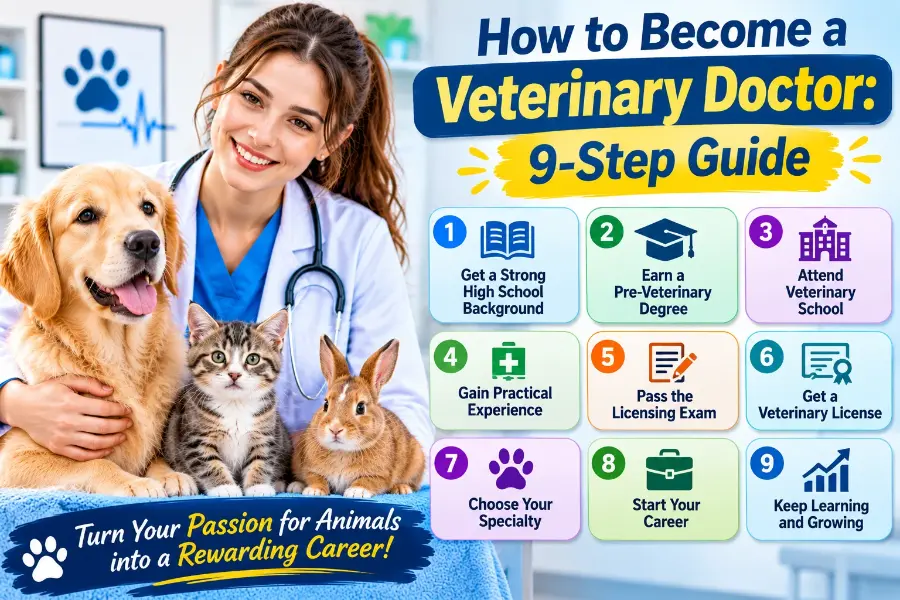
Here are 9 steps on how to become a Veterinary Doctor:
Step 1: Complete Your High School Education
The first step is to complete secondary or high school. Focus on building a strong academic foundation, especially in science subjects.
Subjects such as biology, chemistry, physics, and mathematics can help prepare you for veterinary studies.
During this stage, you can also learn more about animal health by volunteering at animal shelters, helping at farms, or spending time with veterinary professionals when opportunities are available.
Step 2: Focus on Science Subjects
Veterinary medicine is a science-based profession. You need to understand how living organisms function and how diseases affect the body.
Important subjects include:
- Biology: Helps you understand animal anatomy, physiology, and living organisms.
- Chemistry: Provides knowledge about medicines, body processes, and laboratory tests.
- Physics: Helps explain medical equipment and certain diagnostic procedures.
- Mathematics: Supports calculations, measurements, and scientific problem-solving.
Strong knowledge of these subjects can make veterinary education easier to understand.
Step 3: Earn a Bachelor’s Degree or Complete Required Prerequisites
Your next educational step depends on the country and veterinary school you choose.
In some countries, students complete a bachelor’s degree or specific university-level science courses before applying to veterinary school. Common undergraduate subjects include biology, animal science, zoology, and related fields.
In other countries, students can apply directly to a veterinary medicine program after completing secondary education if they meet the admission requirements.
Before choosing a university, check its admission criteria, required subjects, entrance examinations, and academic qualifications.
Step 4: Get Accepted Into a Veterinary School
After meeting the educational requirements, apply to an accredited veterinary school or university.
Admission can be competitive, so you should prepare carefully. Universities may consider your academic grades, science background, entrance examination results, interviews, and relevant animal-care experience.
When selecting a veterinary school, consider:
- Whether the program is officially recognized or accredited.
- The quality of its laboratories and clinical facilities.
- Opportunities for practical training.
- The experience of its teaching staff.
- Whether its degree meets the professional requirements in your intended country of practice.
Choosing a recognized institution is important because it can affect your eligibility for professional registration or licensing.
Step 5: Complete a Veterinary Medicine Degree
Once accepted, you must complete a professional veterinary medicine degree.
Depending on the country, the qualification may be called a Doctor of Veterinary Medicine (DVM), Bachelor of Veterinary Science (BVSc), or another recognized veterinary qualification.
Your studies generally cover subjects such as:
- Animal anatomy and physiology
- Veterinary pathology
- Animal nutrition
- Microbiology and parasitology
- Pharmacology
- Animal diseases
- Veterinary surgery
- Animal reproduction
- Preventive medicine
- Veterinary public health
You will learn how animal bodies function, how diseases develop, and how different medical conditions can be treated.
The duration of veterinary programs varies. Some countries offer direct-entry programs that commonly take around five years, while other pathways require undergraduate study followed by a professional veterinary degree.
Step 6: Gain Practical Experience Through Clinical Training
Practical experience is an essential part of veterinary education. You must learn how to apply classroom knowledge when working with real animals.
During clinical training, students may work under the supervision of experienced veterinarians in teaching hospitals, clinics, farms, and other animal-care facilities.
You may learn how to:
- Examine animals safely.
- Identify common symptoms.
- Collect samples for laboratory testing.
- Assist with medical procedures.
- Handle animals correctly.
- Communicate with animal owners.
- Maintain medical records.
This experience helps you develop confidence and understand the responsibilities of professional veterinary practice.
Step 7: Pass the Required Licensing Examination
After completing your veterinary education, you may need to pass a professional examination before practicing independently.
The examination depends on the country or region where you want to work. For example, veterinarians in the United States generally need to pass the North American Veterinary Licensing Examination (NAVLE) and meet applicable state or territorial requirements.
Other countries have their own registration, assessment, or licensing systems.
Always check the requirements of the official veterinary regulatory authority in your intended location.
Step 8: Obtain Your Veterinary License or Registration
A recognized veterinary degree does not automatically give you permission to practice everywhere.
You may need to register with a veterinary council, licensing board, or professional regulatory organization. Some authorities require additional documents, examinations, supervised experience, or other conditions.
Make sure you understand the local rules before accepting a veterinary position or offering medical services.
Step 9: Start Your Veterinary Career
Once you meet the required qualifications and professional registration conditions, you can begin applying for veterinary jobs.
Many new veterinarians start in private clinics, animal hospitals, or veterinary practices. Others pursue opportunities in farms, government departments, research organizations, wildlife centers, or universities.
As you gain experience, you can develop expertise in a particular area of veterinary medicine or pursue advanced training.
Education Requirements for Veterinary Doctors
Education is one of the most important requirements for becoming a veterinarian. You need a recognized veterinary qualification and must meet the professional standards of the country where you plan to work.

High School Education
Students should complete their secondary or high school education with a strong foundation in science.
Biology and chemistry are particularly useful because they introduce concepts that are important in veterinary medicine.
Undergraduate Education
Some veterinary schools require applicants to complete a bachelor’s degree or specific university-level prerequisite courses before admission.
Biology, zoology, animal science, and related subjects can provide useful preparation.
However, a separate bachelor’s degree is not required in every country. Some veterinary programs allow eligible students to enter directly after high school.
Veterinary Medicine Degree
A professional veterinary degree is the main academic qualification required to become a veterinary doctor.
Depending on the country, it may be called DVM, BVSc, or another recognized qualification.
The program includes classroom learning, laboratory work, clinical education, and supervised practical experience.
Clinical Training and Internships
Practical training helps students develop the skills needed to examine, diagnose, and treat animals.
Clinical rotations and supervised placements also provide experience in different areas of veterinary medicine.
Licensing and Professional Registration
After graduation, you must meet the licensing or registration requirements of your country or region.
These requirements may include examinations, documentation, professional assessments, or supervised practice.
Essential Skills Needed to Become a Veterinary Doctor
Veterinarians need medical knowledge as well as strong personal and professional skills. Working with animals and their owners requires patience, responsibility, and good communication.

Here are some important skills for this career.
Love and Compassion for Animals
A genuine interest in animal welfare is important. Veterinarians regularly work with animals that may be frightened, injured, or seriously ill.
Compassion helps them provide careful and respectful treatment.
Communication Skills
Veterinarians must explain medical conditions and treatment options to animal owners. Good communication helps owners understand their responsibilities and make informed decisions about their animals’ care.
Problem-Solving and Critical Thinking
Animals cannot explain their symptoms in words. Veterinarians must carefully observe their behavior, examine physical signs, and use diagnostic information to identify possible health problems.
Attention to Detail
Small changes in an animal’s behavior, appetite, or physical condition can provide important medical clues.
Paying attention to details helps veterinarians make accurate decisions and avoid mistakes.
Physical Stamina
Veterinary work can involve standing for long periods, lifting or supporting animals, and assisting with demanding procedures.
Good physical stamina can help professionals manage these responsibilities.
Emotional Strength
Veterinarians sometimes deal with serious injuries, terminal illnesses, animal suffering, and difficult decisions.
Emotional strength helps them remain professional while supporting animals and their owners during challenging situations.
Medical and Technical Skills
Veterinary doctors use medical instruments, laboratory equipment, imaging systems, and surgical tools.
They must use these tools safely and interpret the information they provide.
Types of Veterinary Doctors
Veterinary medicine offers several career paths. You can choose a specialization based on your interests, education, and professional experience.
Small Animal Veterinarian
Small animal veterinarians mainly treat household pets such as dogs, cats, rabbits, and other companion animals.
They provide regular checkups, vaccinations, treatments, dental care, and sometimes surgical procedures.
Large Animal Veterinarian
Large animal veterinarians work with animals such as cattle, horses, sheep, and goats.
They often visit farms and agricultural facilities to examine animals, treat diseases, and support livestock health.
Exotic Animal Veterinarian
Exotic animal veterinarians treat animals that are not commonly kept as household pets, such as reptiles, certain birds, and other unusual species.
They need specialized knowledge of different animal species and their medical needs.
Wildlife Veterinarian
Wildlife veterinarians care for wild animals in rehabilitation centers, conservation projects, zoos, and natural habitats.
Their work may involve treating injured animals, monitoring diseases, and supporting wildlife conservation.
Emergency Veterinarian
Emergency veterinarians treat animals that need immediate medical attention.
They may manage serious injuries, poisoning, breathing problems, and other urgent conditions.
Veterinary Surgeon
Veterinary surgeons perform operations to treat injuries and medical conditions.
This career path generally requires additional clinical experience and advanced specialist training.
Veterinary Pathologist
Veterinary pathologists study animal diseases by examining tissues, organs, and laboratory samples.
Their work helps other veterinarians understand diseases and make accurate diagnoses.
Veterinary Researcher
Veterinary researchers study animal diseases, treatments, medicines, and public health concerns.
They may work in universities, laboratories, pharmaceutical organizations, and research institutions.
Where Do Veterinary Doctors Work?
Veterinarians can work in many different environments. Their workplace often depends on their specialization and the animals they treat.
Common workplaces include:
- Private veterinary clinics: Provide examinations, vaccinations, treatments, and routine medical services.
- Animal hospitals: Offer advanced treatment, surgery, emergency care, and diagnostic services.
- Farms and agricultural facilities: Support livestock health, animal reproduction, and disease prevention.
- Zoos and wildlife centers: Provide medical care for wild and exotic animals.
- Government agencies: Work in animal health programs, disease control, food safety, and public health.
- Research laboratories: Study animal diseases, medicines, and medical treatments.
- Universities: Teach veterinary students and conduct scientific research.
- Animal welfare organizations: Help protect animals and provide medical support to animals in need.
These options allow veterinary professionals to build careers in clinical practice, research, education, agriculture, and animal protection.
Veterinary Doctor Salary and Career Outlook
Veterinary doctors can earn different salaries depending on their country, experience, education, specialization, and workplace.
Veterinarians in specialist hospitals or established private practices may have different earning opportunities than those in government services, research, or animal welfare organizations.
Average Veterinary Doctor Salary
In the United States, the U.S. Bureau of Labor Statistics reported a median annual wage of $130,100 for veterinarians in May 2025.
This means half of employed veterinarians earned more than this amount, while half earned less. It is a U.S. figure and should not be treated as a worldwide salary estimate.
Salaries in other countries vary according to local demand, living costs, professional regulations, and employment conditions.
Factors That Affect Veterinary Salaries
Several factors can influence how much a veterinary doctor earns.
- Education and qualifications: Additional professional training may create opportunities for advanced roles.
- Work experience: Experienced veterinarians may qualify for more senior positions.
- Specialization: Certain specialist fields require advanced training and may offer different earning opportunities.
- Location: Salaries can vary by country, city, and rural area.
- Workplace: Private hospitals, government agencies, universities, and research organizations may offer different compensation packages.
- Professional reputation: Strong clinical skills and professional experience can help veterinarians build successful careers.
Job Opportunities and Career Growth
Veterinary medicine offers opportunities in animal healthcare, research, agriculture, public health, and wildlife conservation.
In the United States, employment of veterinarians is projected to grow 9% from 2025 to 2035, according to the Bureau of Labor Statistics. The agency also projects approximately 3,100 job openings per year on average during that period.
These projections apply to the United States. Employment opportunities in other countries depend on their local labor markets and animal healthcare needs.
How Long Does It Take to Become a Veterinary Doctor?
The time required to become a veterinary doctor depends on your country’s education system and professional requirements.
A general pathway may include:
- High school education: Complete the required secondary education.
- Undergraduate education: Some countries require a bachelor’s degree or prerequisite university courses before veterinary school.
- Veterinary medicine degree: Complete the recognized professional veterinary program.
- Clinical training: Gain practical experience through supervised placements and clinical rotations.
- Licensing or registration: Complete any required professional examinations and registration procedures.
In countries with direct-entry veterinary programs, students may complete a professional degree in approximately five years after secondary education. In other countries, the route may take longer because students first complete undergraduate study and then attend veterinary school.
Additional specialist training can add more years to the process.
Advantages of Becoming a Veterinary Doctor
Veterinary medicine can be a meaningful career for people who enjoy science and want to help animals.
Some important advantages include:
Helping Animals Live Healthier Lives
Veterinarians improve animal health by diagnosing illnesses, treating injuries, and preventing diseases.
Knowing that your work can reduce animal suffering is one of the most rewarding parts of this profession.
Meaningful and Rewarding Work
Veterinary doctors support animals and the people who care for them. Helping an injured or sick animal recover can provide a strong sense of professional satisfaction.
Different Career Opportunities
You can work in clinics, hospitals, farms, laboratories, wildlife centers, universities, and government organizations.
Opportunities to Specialize
Veterinarians can develop expertise in areas such as surgery, emergency medicine, animal dentistry, pathology, and wildlife medicine.
Professional Growth
With experience and additional training, veterinarians may move into specialist positions, teaching, research, management, or private practice ownership.
Challenges of Being a Veterinary Doctor
Although veterinary medicine offers many benefits, it also comes with challenges that students should understand before choosing this career.
Long and Demanding Education
Veterinary programs involve extensive scientific study, practical training, and clinical examinations. Students must be prepared to work hard throughout their education.
Emotional Situations and Difficult Decisions
Veterinarians sometimes treat animals with serious or life-threatening conditions. They may also need to discuss difficult treatment choices with owners.
Physically Demanding Work
Examining and handling animals can require physical effort. Some veterinary professionals also work outdoors or travel to farms and other facilities.
Managing Stressful Cases
Emergency cases and busy clinics can create pressure. Veterinarians must remain calm and make responsible decisions when animals need urgent treatment.
Financial Costs of Education
Veterinary education can be expensive in some countries. Tuition fees, equipment, accommodation, and other study expenses should be considered before applying.
Veterinary Doctor vs. Veterinary Technician
Veterinary doctors and veterinary technicians both support animal healthcare, but their education, responsibilities, and professional authority are different.
| Category | Veterinary Doctor | Veterinary Technician |
|---|---|---|
| Education | Professional veterinary degree | Usually a recognized technician or technologist qualification |
| Main role | Diagnoses and treats animal health conditions | Assists veterinarians with examinations and medical procedures |
| Responsibilities | Prescribes treatment and may perform surgery | Performs delegated clinical tasks within local rules |
| Licensing | Usually requires veterinary registration or licensing | May require separate registration or certification |
| Career path | Veterinarian and specialist roles | Technician, technologist, and advanced support roles |
A veterinary doctor diagnoses and manages animal medical conditions. A veterinary technician supports the veterinarian by performing clinical tasks such as collecting samples, preparing animals for procedures, monitoring patients, and assisting with treatment.
Both professions are important, but they require different qualifications and responsibilities.
Tips for Succeeding as a Veterinary Doctor
Becoming a veterinarian is only the beginning. You also need to develop your professional skills and continue learning throughout your career.
Here are some useful tips:
- Gain experience with animals: Volunteer at shelters, farms, animal welfare organizations, or veterinary facilities when possible.
- Build strong science knowledge: Focus on biology, chemistry, and other subjects that support veterinary studies.
- Develop communication skills: Learn how to explain medical information clearly and respectfully.
- Practice patience: Animals may become frightened or uncooperative during examinations, so careful handling is essential.
- Continue learning: Keep up with developments in veterinary medicine, treatments, and animal healthcare technology.
- Build professional relationships: Learn from experienced veterinarians, teachers, and other animal healthcare professionals.
- Consider specialization: Explore different veterinary fields and choose an area that matches your interests and strengths.
These habits can help you become a knowledgeable, responsible, and successful veterinary professional.
FAQs
Here are some common questions about becoming a veterinary doctor, including education, career requirements, salary, and professional opportunities.
The time required depends on the country and its veterinary education system.
- Direct-entry veterinary programs may take approximately five years after secondary education.
- Some countries require undergraduate study followed by a professional veterinary degree.
- Licensing and specialist training may require additional time.
The exact duration depends on your chosen university and professional pathway.
Science subjects are important for students interested in veterinary medicine.
- Biology and chemistry are especially useful for understanding animal bodies and medical treatments.
- Physics and mathematics also support scientific learning and diagnostic work.
Check the admission requirements of your preferred veterinary school before choosing your subjects.
Yes, veterinary medicine can be challenging because it requires years of education and strong scientific knowledge.
- Students must learn anatomy, diseases, medicines, surgery, and animal care.
- Veterinarians also need patience, emotional strength, and practical clinical skills.
However, dedication and consistent learning can help you manage these challenges.
This depends on the country and veterinary school.
- Some countries offer direct-entry veterinary programs after secondary education.
- Other countries require a bachelor’s degree or specific university-level prerequisite courses.
Always check the admission rules of the institution where you plan to study.
The required qualification depends on the country’s education system.
- Common professional qualifications include Doctor of Veterinary Medicine (DVM) and Bachelor of Veterinary Science (BVSc).
- You must complete a degree recognized by the relevant veterinary regulatory authority.
Check whether your qualification will allow you to register and practice in your intended location.
In many countries, veterinary doctors must obtain professional registration or a license before practicing.
- Requirements may include a recognized degree, professional examinations, and supporting documents.
- Some countries also require additional assessments or supervised experience.
Contact the relevant veterinary authority to understand the rules in your area.
Veterinary salaries depend on location, experience, specialization, and workplace.
- In the United States, the median annual wage was $130,100 in May 2025.
- Salaries in other countries can be significantly different because of local economic and employment conditions.
Research current salary information for your country before making career decisions.
Yes, veterinarians can specialize in wildlife medicine and conservation.
- They may work in wildlife rehabilitation centers, zoos, conservation organizations, and research projects.
- Their responsibilities can include treating injured animals and monitoring wildlife diseases.
This career path suits people interested in animal health and wildlife protection.
Veterinarians need a combination of medical, technical, and personal skills.
- Important skills include compassion, communication, problem-solving, attention to detail, and patience.
- They also need scientific knowledge and the ability to handle animals safely.
Developing these skills can help you provide better care and build professional confidence.
Veterinary medicine can be a good career for people who enjoy science and want to improve animal health.
- It offers opportunities in clinical practice, research, agriculture, wildlife care, and public health.
- However, it requires serious educational commitment, practical training, and emotional strength.
Consider your interests, abilities, and long-term goals before choosing this profession.
Choosing veterinary medicine means committing to animal welfare, continuous learning, and responsible medical care. With the right education, practical experience, and dedication, you can build a rewarding career helping animals live healthier lives.
Conclusion
Becoming a veterinary doctor is a meaningful career choice for people who are passionate about animals and interested in medical science. The journey requires a strong educational foundation, a recognized veterinary degree, practical clinical training, and the appropriate professional license or registration.
Start by focusing on science subjects, researching recognized veterinary schools, and gaining experience with animals. As you progress, develop your communication, problem-solving, and medical skills.
Although veterinary medicine can be challenging, it offers opportunities to treat animals, support animal owners, protect public health, and contribute to wildlife conservation. With dedication and continuous learning, you can build a successful career in veterinary medicine.
References
- U.S. Bureau of Labor Statistics (BLS) – Veterinarians: Provides information about veterinary job responsibilities, education requirements, salaries, working conditions, and employment outlook.
https://www.bls.gov/ooh/healthcare/veterinarians.htm - American Association of Veterinary Medical Colleges (AAVMC): Offers guidance about veterinary school admissions, educational requirements, prerequisite courses, and the process of becoming a veterinarian.
https://www.aavmc.org/ - American Association of Veterinary State Boards (AAVSB): Explains professional licensing requirements, veterinary examinations, and registration procedures in the United States and Canada.
https://www.aavsb.org/students-exams/preparing-for-a-veterinary-career/ - International Council for Veterinary Assessment (ICVA): Provides official information about the North American Veterinary Licensing Examination (NAVLE), including eligibility and examination requirements.
https://www.icva.net/navle/ - American Veterinary Medical Association (AVMA): Provides information about veterinary education, accredited veterinary colleges, animal healthcare, and professional development.
https://www.avma.org/




- Be Respectful
- Stay Relevant
- Stay Positive
- True Feedback
- Encourage Discussion
- Avoid Spamming
- No Fake News
- Don't Copy-Paste
- No Personal Attacks
- Be Respectful
- Stay Relevant
- Stay Positive
- True Feedback
- Encourage Discussion
- Avoid Spamming
- No Fake News
- Don't Copy-Paste
- No Personal Attacks
