How to Become a Dentist: Qualifications, Salary and Licensing Requirements
Published: 6 Nov 2026
Dentistry is one of the most respected and financially rewarding careers in healthcare. Dentists play an essential role in maintaining oral health, diagnosing dental diseases, performing surgical procedures, and improving patients’ smiles and confidence.
According to the U.S. Bureau of Labor Statistics, dentist employment is projected to grow 6% from 2022 to 2032, with an average annual salary of more than $160,000 in the United States.
If you are passionate about science, healthcare, and helping others, becoming a dentist could be an excellent career choice. However, the journey requires dedication, years of education, and extensive clinical training.

In this comprehensive guide from CareerFieldly.com, you will learn how to become a dentist, from preparing in high school to completing dental school, obtaining a license, and starting your professional career.
Why Choose a Career in Dentistry?
Before exploring the steps to becoming a dentist, it is helpful to understand why dentistry is an attractive career choice.
Here are five major benefits of pursuing a career in dentistry:
- High Earning Potential: Dentists are among the highest-paid healthcare professionals, with opportunities to earn more through specialization and private practice.
- Job Security: Oral healthcare is essential, creating consistent demand for qualified dental professionals.
- Work-Life Balance: Many dentists enjoy flexible hours, especially those who run private practices.
- Diverse Career Opportunities: You can work as a general dentist, specialist, researcher, or dental educator.
- Personal Satisfaction: Dentists help patients relieve pain, improve oral health, and regain confidence in their smiles.
Overall, dentistry offers a rewarding combination of financial stability, professional growth, flexibility, and the opportunity to improve people’s lives. If these benefits match your interests and career goals, becoming a dentist could be an excellent choice.
The Importance of Overall Health and Personal Care
Good health is closely connected to daily habits, personal hygiene, and proper self-care. Although dentistry focuses on oral health, overall well-being also involves caring for other parts of the body, including the skin.

Understanding Skin Health and Personal Care
Maintaining good health involves more than caring for your teeth. While regular dental checkups and proper oral hygiene are essential, personal care also includes protecting your skin, following healthy daily habits, and choosing suitable skincare products. Healthy skin helps protect the body from external irritants and supports overall well-being.
Learning about common skincare ingredients, their benefits, and how they work can help people make informed decisions about their daily routines. For readers who want to improve their skincare knowledge, this guide to the best skincare ingredients for healthy-looking skin on SkincareHost.com provides more information on ingredients commonly used in skincare products.
Step-by-Step Guide to Becoming a Dentist
Becoming a dentist involves several educational and professional stages. Although the exact requirements depend on your country, the following steps explain the general pathway in the United States.
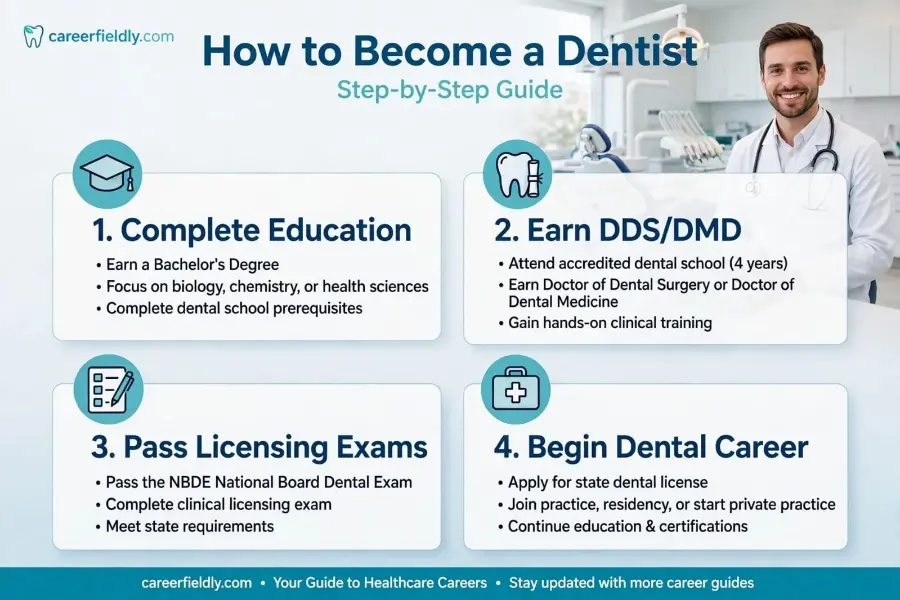
Step 1: Complete High School and Undergraduate Education
Your journey toward becoming a dentist begins in high school. Building a strong academic foundation can help you prepare for dental school admission.
High School Preparation
Focus on science and mathematics subjects, including:
- Biology
- Chemistry
- Physics
- Mathematics
Developing a strong understanding of these subjects will help you handle the scientific coursework required in dental school.
You should also maintain good grades and participate in science clubs, volunteer activities, or opportunities to observe dental professionals.
Earn a Bachelor’s Degree (4 Years)
In the United States and Canada, most dental schools require applicants to complete undergraduate coursework before admission.
Although students can choose different majors, many aspiring dentists study:
- Biology
- Chemistry
- Biochemistry
- Health Sciences
Dental schools typically require prerequisite courses such as:
- General Biology with laboratory
- General Chemistry with laboratory
- Organic Chemistry with laboratory
- Physics with laboratory
- English and Writing
- Mathematics or Calculus
How to Prepare for Dental School During Your Bachelor’s Degree
During your undergraduate education, focus on the following activities:
- Maintain a competitive GPA, preferably 3.5 or higher.
- Gain experience by shadowing a licensed dentist.
- Participate in research and community service.
- Develop leadership and communication skills.
- Build relationships with professors for strong recommendation letters.
These experiences can strengthen your dental school application and help demonstrate your commitment to dentistry.
Step 2: Take the Dental Admission Test (DAT)
The Dental Admission Test (DAT) is a standardized examination used by dental schools in the United States to evaluate applicants’ academic knowledge and problem-solving abilities.
The examination assesses your understanding of scientific concepts, reading skills, and perceptual abilities.
Main Sections of the DAT
The DAT includes four major sections:
- Survey of Natural Sciences: Tests knowledge of Biology, General Chemistry, and Organic Chemistry.
- Perceptual Ability Test (PAT): Measures spatial reasoning and visual problem-solving skills.
- Reading Comprehension: Evaluates your ability to understand and analyze written passages.
- Quantitative Reasoning: Tests mathematical and analytical problem-solving abilities.
How to Prepare for the DAT
A competitive DAT score can improve your chances of admission to dental school. Many applicants aim for scores around 20 or higher, although admission requirements vary.
Consider these preparation strategies:
- Create a study schedule covering all examination sections.
- Practice with sample questions and full-length tests.
- Review important Biology and Chemistry concepts.
- Use preparation resources such as DAT Bootcamp or Kaplan.
- Allow approximately 3–6 months for preparation, depending on your academic background.
Students can take the DAT after completing the necessary prerequisite coursework.
Step 3: Earn a DDS or DMD Degree (4 Years)
After completing your undergraduate education and taking the DAT, the next step is applying to an accredited dental school.
In the United States, applications are commonly submitted through the Association of American Dental Schools Application Service (AADSAS).
Once accepted, you will typically spend four years completing dental school.
What Is the Difference Between DDS and DMD?
DDS stands for Doctor of Dental Surgery, while DMD stands for Doctor of Dental Medicine.
These degrees differ only in name. Both involve equivalent dental education, clinical preparation, and professional licensing requirements. The university determines which degree title it awards.
Dental School Curriculum
Dental school education generally consists of two main stages.
First Two Years: Classroom and Laboratory Training
During the first two years, students focus primarily on theoretical knowledge and laboratory practice.
Common subjects include:
- Human Anatomy
- Physiology
- Pharmacology
- Pathology
- Dental Materials
- Oral Biology
- Dental Procedures
Students also practice basic dental techniques using simulation models and manikins.
Last Two Years: Clinical Training
The final two years focus heavily on practical experience and patient care.
Under the supervision of experienced dental faculty, students learn to perform procedures such as:
- Dental fillings
- Root canal treatments
- Tooth extractions
- Professional teeth cleaning
- Basic restorative procedures
This clinical experience prepares students to manage different dental conditions and provide appropriate patient care.
How Much Does Dental School Cost?
Dental school in the United States can be expensive. The total cost of education may range from approximately $200,000 to $400,000, depending on the institution, tuition, and living expenses.
However, students may reduce their financial burden through scholarships, grants, and other financial aid programs.
Some well-known dental schools include:
- Harvard School of Dental Medicine
- University of Michigan School of Dentistry
- NYU College of Dentistry
Step 4: Pass Dental Licensing Examinations
Graduating from dental school does not automatically qualify you to practice dentistry independently.
You must meet the licensing requirements established by the relevant dental regulatory authorities.
In the United States, the process generally involves the following examinations and requirements.
1. Integrated National Board Dental Examination (INBDE)
The INBDE is a comprehensive examination that evaluates your knowledge of biomedical sciences, clinical dentistry, and patient management.
It replaced the former National Board Dental Examination (NBDE) Part I and Part II.
2. Clinical Licensing Examination
Depending on the state, graduates may need to complete an accepted clinical assessment to demonstrate their practical dental skills.
Common examination organizations and systems include:
- ADEX (American Board of Dental Examiners)
- WREB (Western Regional Examining Board)
- CDCA-related examination services
Specific examination acceptance depends on state regulations.
3. State-Specific Licensing Requirements
Each state has its own dental licensing rules. Additional requirements may include:
- Jurisprudence examination covering dental laws and ethics
- CPR certification
- Background checks
- Required application documents
- Other state-specific qualifications
Always check the relevant state dental board for current licensing requirements.
Step 5: Choose a Dental Career Path and Start Practicing
After completing dental school and obtaining the required license, you can begin your professional career.
Dentistry offers several career opportunities depending on your interests, skills, and long-term goals.
A. Become a General Dentist
Most dental graduates begin their careers as general dentists.
General dentists provide primary oral healthcare services, including:
- Routine dental examinations
- Teeth cleaning
- Dental fillings
- Preventive dental care
- Basic restorative treatments
- Diagnosing common oral health problems
B. Specialize in Dentistry
If you want to focus on a particular area of oral healthcare, you can pursue postgraduate dental training.
Depending on the specialty, residency programs generally take approximately 2–6 years.
Popular dental specialties include:
- Orthodontics: Focuses on correcting misaligned teeth and jaw problems using braces and other treatments.
- Oral and Maxillofacial Surgery: Involves surgical treatment of conditions affecting the mouth, jaw, and face.
- Endodontics: Specializes in treating diseases and injuries affecting dental pulp, including root canal procedures.
- Periodontics: Focuses on preventing and treating gum diseases.
- Pediatric Dentistry: Provides dental care for infants, children, and teenagers.
- Prosthodontics: Specializes in restoring and replacing missing or damaged teeth.
C. Choose Your Employment Setting
Dentists can work in several professional environments, including:
- Private dental clinics
- Group dental practices
- Hospitals
- Community health centers
- Military healthcare facilities
- Universities and research institutions
Some experienced dentists also establish their own dental clinics and manage independent practices.
How to Become a Dentist in Different Countries
Educational pathways and licensing requirements for dentists vary by country. Before choosing a dental school, understand the requirements of your intended workplace.
Here is an overview of the general pathways in five countries.
1. How to Become a Dentist in the USA
In the United States, aspiring dentists typically complete:
- A bachelor’s degree or the required undergraduate coursework.
- A four-year DDS or DMD dental program.
- The Integrated National Board Dental Examination (INBDE).
- Applicable clinical assessments and state licensing requirements.
After fulfilling these requirements, graduates can apply for a dental license in their chosen state.
2. How to Become a Dentist in the UK
In the United Kingdom, students generally complete a five-year Bachelor of Dental Surgery (BDS) degree at a recognized dental school.
The typical pathway includes:
- Completing A-levels or equivalent qualifications, usually with strong results in Chemistry and Biology.
- Gaining admission to an approved dental school.
- Completing the five-year BDS program.
- Undertaking Dental Foundation Training or meeting the applicable registration requirements.
- Registering with the General Dental Council (GDC).
3. How to Become a Dentist in Canada
The Canadian pathway is similar to the American system in several respects.
Students generally need to:
- Complete the required undergraduate education and prerequisite courses.
- Gain admission to an accredited dental school.
- Earn a DDS or DMD degree.
- Meet the National Dental Examining Board of Canada (NDEB) examination and certification requirements.
- Fulfill applicable provincial or territorial licensing requirements.
4. How to Become a Dentist in Australia
Australia offers undergraduate and graduate-entry dental programs.
The general pathway includes:
- Completing a recognized five-year Bachelor of Dental Science (BDSc) or equivalent undergraduate dental program, or an approved graduate-entry pathway.
- Completing the required clinical training.
- Meeting the Dental Board of Australia’s registration requirements.
- Registering through the Australian Health Practitioner Regulation Agency (AHPRA).
5. How to Become a Dentist in Pakistan
In Pakistan, students generally pursue a Bachelor of Dental Surgery (BDS) degree after completing their intermediate education or an equivalent qualification.
The typical pathway includes:
- Completing FSc Pre-Medical or an equivalent qualification.
- Meeting the admission requirements for a recognized dental college.
- Passing the required admission test.
- Completing the BDS degree.
- Completing the required house job or internship.
- Meeting the Pakistan Medical and Dental Council (PMDC) licensing and registration requirements.
Students should check the latest PMDC regulations for current degree duration, examination, house job, and licensing requirements.
Essential Skills Every Dentist Needs
Becoming a successful dentist requires more than academic qualifications. Dental professionals need a combination of technical, communication, and interpersonal skills to provide effective patient care.
Here are some important skills for a dental career:
- Manual Dexterity and Hand-Eye Coordination: Dentists perform delicate procedures that require precise hand movements and excellent coordination.
- Attention to Detail: Identifying small dental problems and performing accurate treatments requires careful observation.
- Communication and Empathy: Dentists must explain procedures, understand patient concerns, and make patients feel comfortable.
- Problem-Solving Skills: Diagnosing dental conditions and selecting appropriate treatments require strong analytical abilities.
- Business Management: Dentists who own private practices benefit from financial management, leadership, and organizational skills.
Developing these skills during your education and clinical training can help you become a more confident and effective dental professional.
How Much Does a Dentist Earn?
Dentist salaries vary by country, qualifications, specialization, experience, and employment setting.
Here is an approximate overview of annual and monthly earning ranges:
| Country | Approximate Salary |
|---|---|
| USA | $163,220 per year |
| UK | £50,000–£90,000 per year |
| Canada | CAD $100,000–$200,000 per year |
| Australia | AUD $80,000–$150,000 per year |
| Pakistan | PKR 80,000–300,000 per month |
These figures are general estimates and may vary significantly by location and individual practice.
Experienced specialists and dentists who operate successful private clinics may earn considerably more than newly qualified professionals.
Conclusion
Becoming a dentist is a challenging but rewarding career journey that requires academic dedication, practical training, and a genuine interest in helping people maintain their oral health.
In the United States, the traditional pathway takes approximately eight years, including four years of undergraduate education and four years of dental school. Additional residency training is required for those who want to specialize.
By choosing the right educational pathway, preparing for dental school admission, earning a DDS or DMD degree, and completing the required licensing steps, you can work toward a successful career in dentistry.
If you are passionate about healthcare, science, and improving people’s lives, dentistry can offer excellent professional and personal opportunities.
For more career guides and educational resources on healthcare professions, explore CareerFieldly.com – Your Guide to Healthcare Careers.
FAQs
Here are answers to some common questions about becoming a dentist, including education requirements, career duration, licensing, and salary expectations.
Becoming a dentist in the United States typically takes around eight years after high school. The exact duration depends on the country, educational pathway, and specialization.
The typical timeline includes:
- Undergraduate education: 4 years
- Dental school: 4 years
- Specialization: An additional 2–6 years, depending on the field
Therefore, you can generally become a licensed general dentist in approximately eight years in the United States.
Yes, becoming a dentist can be challenging because it requires strong academic performance, practical skills, and several years of professional training.
Some common challenges include:
- Completing demanding Biology and Chemistry coursework.
- Getting accepted into a competitive dental school.
- Passing dental admission and licensing examinations.
- Developing precise hand-eye coordination and clinical skills.
- Managing the academic and financial demands of dental education.
However, with consistent preparation, dedication, and practical experience, becoming a dentist is achievable.
Yes, in some countries, students can enter dental school directly after completing their secondary education and meeting the required admission criteria.
The requirements vary by country:
- USA: Most dental schools require undergraduate coursework, but a completed bachelor’s degree is not universally mandatory.
- UK: Students can enter approved five-year dental programs after completing A-levels or equivalent qualifications.
- Australia: Some dental programs accept students directly after secondary education.
- Pakistan: Students can pursue BDS after completing FSc Pre-Medical or an equivalent qualification and meeting admission requirements.
Therefore, a bachelor’s degree isn’t required for every dental education pathway.
Students interested in dentistry should focus on science subjects because dental education involves understanding the human body, oral health, and medical conditions.
Important subjects include:
- Biology: Helps you understand human anatomy and body systems.
- Chemistry: Provides knowledge of chemical reactions and dental materials.
- Physics: Helps explain dental equipment and certain clinical procedures.
- Mathematics: Develops analytical and problem-solving abilities.
- English: Improves communication and academic writing skills.
Building a strong foundation in these subjects can help you prepare for dental school admission and professional training.
DDS and DMD are two different degree titles awarded to qualified dental students in the United States. However, both degrees represent the same level of professional dental education.
Here is what the abbreviations mean:
- DDS: Doctor of Dental Surgery.
- DMD: Doctor of Dental Medicine.
Both programs provide similar academic education, clinical training, and professional preparation. The dental school decides which degree title to award.
The cost of becoming a dentist depends on the country, university, tuition fees, and living expenses.
In the United States, dental school alone may cost approximately $200,000–$400,000, although actual expenses vary considerably.
Major expenses may include:
- Undergraduate tuition fees.
- Dental school tuition.
- Books and learning materials.
- Clinical equipment and supplies.
- Accommodation and living expenses.
- Licensing and examination fees.
Students can explore scholarships, grants, and financial aid programs to help reduce their educational expenses.
Yes, dentists can pursue additional postgraduate education to specialize in a particular area of dentistry. Specialization allows dental professionals to develop advanced knowledge and clinical skills.
Popular dental specialties include:
- Orthodontics: Corrects misaligned teeth and jaw problems.
- Oral and Maxillofacial Surgery: Focuses on surgical procedures involving the mouth, jaw, and face.
- Endodontics: Specializes in root canal treatments and dental pulp conditions.
- Periodontics: Treats gum disease and the structures that support teeth.
- Pediatric Dentistry: Provides oral healthcare for children.
- Prosthodontics: Restores and replaces missing or damaged teeth.
Most dental specialties require additional residency training, which can take approximately 2–6 years depending on the program.
Dentist salaries vary by country, experience, specialization, and employment setting. General dentists and specialists may also earn different amounts.
Approximate earning ranges include:
- USA: Around $163,220 per year.
- UK: Approximately £50,000–£90,000 per year.
- Canada: Approximately CAD $100,000–$200,000 per year.
- Australia: Approximately AUD $80,000–$150,000 per year.
- Pakistan: Approximately PKR 80,000–300,000 per month.
These figures are general estimates, not guaranteed salaries. Experienced dentists and private practice owners may earn more, depending on their location and patient base.
With experience, specialization, and professional development, dentists can build rewarding and financially successful careers.
Still have questions about pursuing a career in dentistry? Explore more healthcare career guides on CareerFieldly.com to learn about educational pathways, professional requirements, and career opportunities.





- Be Respectful
- Stay Relevant
- Stay Positive
- True Feedback
- Encourage Discussion
- Avoid Spamming
- No Fake News
- Don't Copy-Paste
- No Personal Attacks
- Be Respectful
- Stay Relevant
- Stay Positive
- True Feedback
- Encourage Discussion
- Avoid Spamming
- No Fake News
- Don't Copy-Paste
- No Personal Attacks
