How to Find Remote Jobs With No Experience: A Beginner’s Guide
Published: 18 Nov 2026
Finding a remote job without previous work experience can seem difficult, especially when many employers list experience as a requirement. However, you can start a remote career if you know which positions to target, how to show your abilities, and where to find legitimate opportunities.
Remote work allows people to apply for suitable positions without commuting to an office every day. Depending on the employer, you may work from home, communicate with colleagues online, and complete your responsibilities using a computer and an internet connection. Some companies offer entry-level positions that provide training, while others expect applicants to demonstrate basic skills before hiring.
The good news is that previous employment isn’t the only way to show your potential. Education, personal projects, volunteer activities, online courses, and practical skills can all help strengthen your application.
In this guide, you will learn how to find remote jobs with no experience, which beginner-friendly positions to consider, how to prepare your resume, where to search for opportunities, and how to protect yourself from employment scams.
What Are Remote Jobs?
Remote jobs are positions that let employees work outside a traditional office. Instead of travelling to a workplace every morning, employees use digital tools such as email, video meetings, messaging applications, and online work platforms to complete their responsibilities.
Some remote employees work entirely from home, while others can work from different approved locations. The exact arrangement depends on company policies and the position.
There are three common types of remote work:
- Fully remote jobs: Employees do not need to attend a company office regularly, although some employers may require occasional meetings or travel.
- Hybrid jobs: Employees divide their working time between home and an office.
- Freelance remote work: Independent professionals complete projects for clients rather than working as permanent employees.
Understanding these arrangements matters because a job advertised as remote may still require a specific location, time zone, or office attendance.
Can You Get a Remote Job With No Experience?
Yes, you can apply for remote jobs without previous professional experience. However, that doesn’t mean every remote employer accepts applicants without qualifications or skills.
Entry-level positions are generally designed for people starting their careers or moving into a new industry. Some employers provide initial training and focus more on communication, reliability, organization, and willingness to learn than on an extensive employment history.
For example, someone who has never worked as a customer service representative may still have useful experience helping people, answering questions, resolving everyday problems, or communicating clearly.
Similarly, a student who regularly creates presentations, manages online projects, or writes assignments may already have skills relevant to administrative or content-related work.
The key is to identify what you can offer and explain how those abilities match the employer’s requirements.
Remember that entry-level does not always mean no experience is required. Read each job description carefully and distinguish between essential qualifications and skills that the employer is willing to teach.
Best Remote Jobs for Beginners With No Experience
Choosing the right position is one of the most important steps when starting a remote career. Instead of applying for every available opportunity, focus on jobs that match your current abilities and interests.
Here are eight options worth exploring.
1. Virtual Assistant
A virtual assistant provides remote administrative support to individuals, entrepreneurs, and businesses.
Typical responsibilities may include:
- Organizing appointments and calendars.
- Managing business emails.
- Preparing documents and spreadsheets.
- Updating customer information.
- Researching information online.
- Organizing digital files.
This position can suit beginners who are organized, dependable, and comfortable using basic computer applications.
You may not need previous virtual assistant experience for every entry-level opportunity. However, employers may expect you to understand email communication, document preparation, scheduling, and online collaboration tools.
2. Customer Service Representative
Customer service representatives help customers with questions, complaints, orders, and general product or service information.
Remote customer service positions may involve answering telephone calls, responding to emails, or communicating through live chat.
Common responsibilities include:
- Responding politely to customer questions.
- Explaining products and services.
- Helping customers resolve basic problems.
- Recording customer interactions.
- Forwarding complex issues to the appropriate department.
Good communication and patience are particularly important for this role.
Some companies hire beginners and provide training on their customer service systems. However, certain positions require previous experience, strong language skills, or specific working hours.
3. Data Entry Clerk
Data entry clerks enter, organize, and update information in digital systems.
Their responsibilities may include:
- Entering information into spreadsheets.
- Updating business records.
- Checking documents for accuracy.
- Organizing customer information.
- Reviewing data for missing details.
This work may appeal to people who enjoy organized, repetitive tasks and have strong attention to detail.
Basic typing ability, spreadsheet knowledge, and accuracy can help you qualify for suitable opportunities.
Be especially careful when searching for data entry jobs. This category attracts misleading advertisements promising unusually high earnings for very little work. Always verify the employer before sharing personal information.
4. Online Chat Support Agent
Online chat support agents communicate with customers through website chat systems or messaging platforms.
Unlike telephone-based customer service, many chat support positions involve written communication.
You may be responsible for:
- Answering frequently asked questions.
- Helping customers understand company services.
- Checking order or account information.
- Providing basic troubleshooting instructions.
- Escalating complicated customer problems.
Strong written communication, accurate typing, and the ability to understand customer concerns are useful skills.
Some employers provide scripts and training materials to help new employees respond consistently.
5. Content Writing Assistant
Businesses, websites, and digital publications need written content for articles, product descriptions, website pages, and social media.
A content writing assistant may research topics, prepare drafts, proofread documents, or update existing website content.
You can begin developing relevant skills by writing sample articles on subjects you understand.
For example, create two or three original articles that demonstrate your ability to organize information, use headings, explain ideas clearly, and write for a particular audience.
A small portfolio can help employers evaluate your writing ability even if you haven’t worked professionally as a writer.
6. Social Media Assistant
A social media assistant helps businesses maintain their presence on platforms such as Facebook, Instagram, LinkedIn, and other relevant networks.
Responsibilities may include:
- Preparing social media captions.
- Scheduling posts.
- Organizing content calendars.
- Responding to basic comments.
- Researching relevant hashtags.
- Preparing simple graphics.
This position can suit people who already understand social media platforms and enjoy creating digital content.
However, personal social media use is not the same as professional social media management. Learn how businesses plan content, communicate with customers, and maintain consistent branding.
You can create a sample content calendar for a fictional business to demonstrate your abilities.
7. Transcriptionist
Transcriptionists listen to audio or video recordings and convert spoken words into written documents.
Depending on the project, the recordings may include interviews, meetings, educational materials, or general discussions.
Useful skills include:
- Accurate typing.
- Good listening ability.
- Grammar and punctuation.
- Attention to detail.
- Understanding different accents.
Some transcription opportunities require applicants to complete a typing or listening assessment before accepting work.
Specialized transcription, particularly in medical or legal settings, may require additional training and subject knowledge. Beginners should look for general transcription opportunities that match their current abilities.
8. Online Tutor or Homework Support Assistant
People with strong knowledge of a particular subject may explore online tutoring opportunities.
Tutors help students understand academic subjects, practise skills, and prepare for examinations.
Possible subjects include:
- English language.
- Mathematics.
- Science.
- Computer basics.
- Other subjects you know well.
Some platforms require formal qualifications, teaching experience, or subject-specific credentials. Others may offer opportunities for people with demonstrated subject knowledge.
Always check the educational requirements before applying.
Skills You Need to Get Your First Remote Job
You do not need to master every digital skill before applying for your first remote position. However, developing a few essential abilities can make you a stronger candidate.
Communication Skills
Remote employees often communicate through emails, messages, online meetings, and project management systems.
You should be able to explain information clearly, ask relevant questions, respond professionally, and understand instructions.
Good communication is especially important when working with customers or colleagues in different locations.
Basic Computer Skills
Most remote positions require regular computer use.
You should understand how to:
- Use a web browser.
- Manage files and folders.
- Send and receive emails.
- Create and edit documents.
- Use spreadsheets.
- Join online meetings.
Learning basic applications such as Google Docs, Google Sheets, Microsoft Word, and Microsoft Excel can be a useful starting point.
Time Management
Working remotely often requires employees to organize their daily responsibilities without constant supervision.
You should be able to follow schedules, prioritize tasks, meet deadlines, and communicate when you need assistance.
Problem-Solving
Employers value people who can understand a problem, follow instructions, and find an appropriate solution.
You do not need to know everything. Knowing when to research an issue or ask a supervisor for help is also an important professional skill.
Willingness to Learn
Many entry-level employees develop their skills after joining a company.
Showing that you are willing to learn new software, follow training, accept feedback, and improve your performance can help demonstrate your potential.
How to Find Remote Jobs With No Experience: 8-Step Guide
Finding a suitable position requires more than searching for work-from-home opportunities. A focused approach can help you avoid unsuitable ads and spend more time applying for roles that match your abilities.
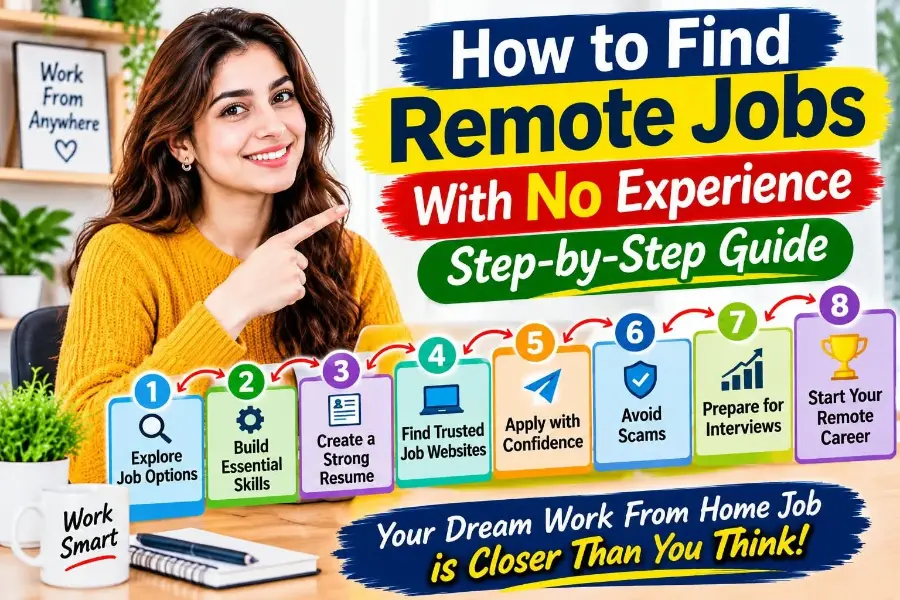
Here are 8 steps on how to find remote jobs with no experience:
Step 1: Identify Your Skills and Interests
Start by listing the things you can already do.
For example:
- If you communicate well, consider customer support.
- If you enjoy organizing information, explore virtual assistant positions.
- If you have good writing skills, consider content-related work.
- If you are comfortable with spreadsheets, explore data entry.
- If you understand social platforms, consider social media assistance.
Also consider the type of work environment you prefer.
Some positions involve regular customer interaction, while others require independent tasks and fewer meetings.
Choosing a suitable field makes it easier to prepare a focused resume and search for relevant opportunities.
Step 2: Choose One or Two Entry-Level Job Categories
Avoid applying randomly for dozens of unrelated positions.
Instead, choose one or two job categories that match your existing abilities.
For example, you could focus on virtual assistant and administrative support positions. Both may involve organizing information, managing emails, and preparing documents.
Alternatively, customer service and online chat support may be suitable if you enjoy helping people.
A focused approach helps you build relevant skills and prepare stronger applications.
Step 3: Learn the Basic Skills Required
Read several job descriptions for the positions you want.
Identify the tools, qualifications, and abilities that employers mention repeatedly.
If you notice that most virtual assistant positions require spreadsheet knowledge, spend time learning basic spreadsheet functions.
If you want to work in customer support, practise professional email writing and customer communication.
Free learning resources, online tutorials, and introductory courses can help you develop these abilities. However, choose training that directly supports your target position rather than collecting unrelated certificates.
Step 4: Prepare a Professional Resume
Your resume should clearly explain why you are suitable for the position.
If you have no formal employment history, do not leave the document empty or invent previous jobs.
Instead, include:
- Your name and professional contact information.
- A short career summary.
- Relevant skills.
- Education and training.
- Volunteer activities, if applicable.
- Personal projects.
- Relevant certifications.
For example, if you are applying for a virtual assistant position, highlight organization, email communication, document preparation, and scheduling skills.
Use a simple format with clear headings and readable fonts. Adjust your resume for each position by including relevant skills mentioned in the job description.
Step 5: Build a Small Portfolio
A portfolio is a collection of examples that demonstrates what you can do.
It can be particularly useful when applying for writing, design, social media, administrative, and other skill-based positions.
You do not need paid clients to create your first samples.
Examples include:
- A sample article for a content writing position.
- A spreadsheet showing organized information.
- A sample weekly schedule for a virtual assistant role.
- A social media content calendar.
- A professionally written customer service email.
Clearly label practice projects as samples rather than presenting them as paid professional work.
A small collection of relevant examples can give employers a better understanding of your abilities.
Step 6: Search on Reliable Job Websites
Use established job platforms and official company career pages to discover remote opportunities.
Search with specific terms such as:
- Entry-level remote jobs.
- Remote customer service representative.
- Work-from-home virtual assistant.
- Remote data entry clerk.
- Junior content writer remote.
- Remote chat support agent.
Apply filters for experience level, job type, location, and remote work where available.
Remember that a remote position advertised by a US employer may only be open to applicants living in particular states or countries.
Always read the location and eligibility requirements before applying.
Step 7: Submit Targeted Applications
Once you find a suitable position, carefully review its responsibilities and qualifications.
Prepare your resume according to the employer’s requirements and include a short cover letter when appropriate.
Explain why you are interested in the role, which relevant skills you possess, and how you are prepared to learn.
Avoid sending identical applications to every company. A tailored application demonstrates that you understand the position and have taken the time to review the employer’s needs.
Step 8: Prepare for Online Interviews
If an employer invites you to an interview, prepare in advance.
Research the company, review the job description, and practise answering common questions.
You may be asked:
- Why do you want to work remotely?
- How do you organize your daily tasks?
- How would you handle a difficult customer?
- What computer applications can you use?
- How do you manage deadlines?
- What would you do if you did not understand an assignment?
Be honest about your experience. Explain what you already know and how you would approach learning unfamiliar tasks.
Before the interview, test your internet connection, microphone, camera, and meeting software.
Best Websites to Find Remote Jobs for Beginners
Using appropriate job platforms can make your search more organized. The following websites are useful starting points, although individual vacancies may have different eligibility requirements.
1. Indeed
Website: https://www.indeed.com/
Indeed provides job listings across different industries and experience levels. You can search using job titles and remote-work terms, then narrow results using available filters.
Try searching for “entry-level remote customer service” or “remote virtual assistant.”
2. LinkedIn
Website: https://www.linkedin.com/
LinkedIn combines professional networking with job searching.
You can create a professional profile, highlight your skills, follow companies, connect with recruiters, and search for remote opportunities.
Keep your profile information accurate and consistent with your resume.
3. Remote.co
Website: https://remote.co/
Remote.co focuses on remote work opportunities and information about working remotely.
Explore its job listings to identify positions that match your interests and qualifications.
4. We Work Remotely
Website: https://weworkremotely.com/
We Work Remotely lists opportunities from companies recruiting for remote positions.
Categories and experience requirements vary, so review each vacancy before applying.
5. FlexJobs
Website: https://www.flexjobs.com/
FlexJobs specializes in flexible and remote employment opportunities.
Check its current membership and pricing information before signing up, as access to certain features requires payment.
6. Upwork
Website: https://www.upwork.com/
Upwork is a freelance marketplace where clients hire independent professionals for specific projects.
Beginners may explore services such as writing, virtual assistance, research, and administrative support.
Remember, freelance work differs from permanent employment. Earnings, project availability, and client requirements can vary.
How to Create a Resume Without Work Experience
A lack of formal employment history does not mean you have nothing valuable to show employers.
The goal is to demonstrate relevant abilities rather than focus only on previous job titles.
Start with a short professional summary explaining the type of position you want and your strongest relevant skills.
For example:
“Motivated entry-level applicant with strong written communication, organization, and basic computer skills. Interested in remote administrative support and eager to develop professional experience through training and practical work.”
Next, create a skills section that includes abilities relevant to the vacancy.
You can also include education, online training, volunteer activities, and personal projects.
If you have completed a project that demonstrates your ability to organize information, communicate professionally, or use digital tools, describe it briefly.
Keep your resume accurate, easy to read, and preferably one page when your experience is limited.
How to Avoid Remote Job Scams
Unfortunately, fake work-from-home advertisements can target people urgently looking for employment or with little professional experience.
Be careful when evaluating opportunities, especially those promising unusually high earnings for simple tasks.
Watch for these warning signs:
Requests for Upfront Payments
A legitimate employer should not require you to pay a recruitment fee or purchase a guaranteed job opportunity.
Be cautious if someone asks for payment to unlock a vacancy, receive training, or secure an interview.
Fake Equipment Payments
Some scammers send fraudulent cheques and instruct applicants to purchase equipment from a particular supplier or transfer money elsewhere.
Do not deposit suspicious payments or send money back to someone who claims to be your employer.
Verify equipment arrangements directly through the company’s official contact channels.
Unusually Generous Salary Promises
Be suspicious of advertisements offering exceptional salaries for a few minutes of simple work without explaining the responsibilities.
Compare the advertised compensation with the actual duties, working hours, and qualifications.
Unverified Company Information
Check whether the company has an official website, a verifiable business presence, and legitimate contact information.
If you receive an offer, independently contact the employer using details published on its official website rather than relying only on information provided by the recruiter.
Requests for Sensitive Personal Information
Do not share banking passwords, verification codes, or unnecessary identity documents with an unverified recruiter.
Legitimate employers may need certain personal and financial information during formal hiring and payroll procedures, but the timing and method of collection matter.
If something seems suspicious, stop communicating and report the advertisement through the platform where you found it.
Common Mistakes Beginners Should Avoid
Many first-time applicants make avoidable mistakes that can weaken their chances of finding remote employment.
Applying for every available position: Sending applications without checking the requirements wastes time. Focus on jobs that match your abilities.
Using the same resume everywhere: Different positions require different skills. Adjust your resume to highlight the abilities most relevant to each vacancy.
Ignoring job descriptions: Check the location restrictions, schedule, responsibilities, qualifications, and employment type before applying.
Exaggerating your abilities: Never claim professional experience or technical knowledge you don’t have. Employers may test your skills during the hiring process.
Expecting immediate results: Finding employment takes time. Some positions receive many applications, and employers may take several weeks to complete their selection process.
Ignoring skill development: If you repeatedly find a particular requirement in job advertisements, consider learning that skill before submitting more applications.
How Much Can Beginners Earn From Remote Jobs?
There is no single salary for remote beginners because earnings depend on the position, employer, location, working hours, qualifications, and employment arrangement.
For example, a full-time customer service representative may receive an hourly wage or an annual salary. A freelance content writer may be paid per article or project, while a virtual assistant may charge an hourly rate or agree on a monthly arrangement with a client.
Before accepting an offer, check:
- The hourly rate or total compensation.
- Expected weekly working hours.
- Whether the position is full-time or part-time.
- Whether training is paid.
- Whether the role is employment or independent contracting.
- Payment schedule and any additional conditions.
If you are applying for US-based positions, compare compensation with applicable federal, state, and local requirements. Applicants in other countries should also check the employment and payment rules that apply where they live.
Do not choose a position based only on an advertised salary. Consider the actual responsibilities, working conditions, and the employer’s legitimacy.
Tips to Increase Your Chances of Getting Hired
A successful remote job search requires consistency and preparation.
Here are some practical ways to improve your applications:
Improve your digital skills: Learn the applications commonly used in your chosen field, such as spreadsheets, document editors, email tools, and online meeting platforms.
Create a professional online presence: Keep your LinkedIn profile updated and make sure your professional information matches your resume.
Prepare before applying: Read job descriptions and identify the skills employers repeatedly request.
Build practical examples: A portfolio can help demonstrate your abilities when your employment history is limited.
Set a regular application schedule: Dedicate time to searching, reviewing vacancies, preparing applications, and following up professionally.
Practise communication: Improve your written communication and prepare clear answers to common interview questions.
Stay realistic: Your first remote position may be part-time, temporary, freelance, or entry-level. It can still help you develop experience and prepare for future opportunities.
FAQs
Have questions about finding remote jobs without previous experience? Here are answers to some of the most common questions to help you understand your options, prepare for applications, and start your remote career with confidence.
Yes! Many employers offer entry-level remote positions for beginners. You may need basic skills and computer knowledge, but you don’t always need previous professional experience.
What you should have:
- Basic computer skills.
- Good communication.
- Willingness to learn.
- Ability to complete assigned tasks.
Remember: You can build your career even if you are starting from zero.
The easiest remote job depends on your skills and interests. Some beginner-friendly opportunities include:
- Data entry clerk.
- Customer service representative.
- Virtual assistant.
- Online chat support agent.
- Social media assistant.
Remember: Choose a position that matches your abilities rather than focusing only on how easy the work appears.
Yes! Some entry-level remote positions require only basic computer knowledge. However, improving your digital skills can help you qualify for more opportunities.
Start by learning:
- Email communication.
- Internet browsing.
- Microsoft Word and Excel.
- Google Docs and Sheets.
- Online meeting applications.
Remember: Developing a few essential digital skills can make it easier to find your first remote job.
Several established platforms let beginners explore remote job opportunities.
Useful websites include:
- Indeed: https://www.indeed.com/
- LinkedIn: https://www.linkedin.com/
- Remote.co: https://remote.co/
- We Work Remotely: https://weworkremotely.com/
- FlexJobs: https://www.flexjobs.com/
Remember: Always check the employer’s identity, job requirements, and location restrictions before applying.
No, not every remote position requires a college degree. Some employers prioritize practical skills, communication, and the ability to perform specific tasks.
You may find opportunities in:
- Customer support.
- Data entry.
- Virtual assistance.
- Social media assistance.
- Freelance writing.
However, specialized professions may require formal education, certifications, or professional licenses.
Remember: Focus on positions that match your qualifications and current skill level.
Protecting yourself from fake employment opportunities is essential when searching for work online.
Follow these safety tips:
- Never pay upfront to secure a job.
- Avoid unrealistic salary promises.
- Verify the company’s official website.
- Do not share banking passwords or verification codes.
- Check the recruiter’s identity.
- Be cautious of suspicious payment or equipment arrangements.
Remember: A genuine job opportunity should have clear responsibilities, verifiable employer information, and transparent hiring procedures.
There is no guaranteed timeline for finding remote employment. It depends on your skills, qualifications, location, competition, and available vacancies.
You can improve your chances by:
- Updating your resume.
- Learning relevant digital skills.
- Applying for suitable positions regularly.
- Preparing for online interviews.
- Building a small portfolio.
Remember: Stay consistent, keep improving your skills, and don’t get discouraged if your first applications aren’t successful.
You don’t need years of professional experience to start exploring remote career opportunities. Start with your existing skills, keep learning, and apply for positions that match your abilities.
Conclusion
Finding remote jobs with no experience is possible, but it requires a realistic plan and a willingness to develop relevant skills. You don’t need an impressive employment history to start. You need to understand what employers expect, identify suitable entry-level opportunities, and demonstrate that you can handle the responsibilities.
Start by choosing one or two job categories, improving the skills those positions require, and preparing a professional resume. Use established job platforms, explore official company websites, and carefully check every opportunity before applying.
Most importantly, do not let a lack of previous experience stop you from taking the first step. A small project, a new digital skill, or a well-prepared application can help you move closer to your first remote opportunity.
Your remote career does not have to start with years of experience. It can start with the skills you build today and the effort you put into finding the right opportunity.
You May Also Like
If you are exploring remote work opportunities or planning your career, you may also find these helpful guides:
- How to Become a Data Analyst – Discover the education, technical skills, tools, and steps needed to start a career in data analytics.
- How to Become a Software Developer – Learn about programming skills, education, career opportunities, and how to enter the software development industry.
- How to Become a Graphic Designer – Explore the creative skills, design tools, training, and career opportunities available in graphic design.
Explore these guides to discover more career paths and find opportunities that match your interests and skills.



- Be Respectful
- Stay Relevant
- Stay Positive
- True Feedback
- Encourage Discussion
- Avoid Spamming
- No Fake News
- Don't Copy-Paste
- No Personal Attacks
- Be Respectful
- Stay Relevant
- Stay Positive
- True Feedback
- Encourage Discussion
- Avoid Spamming
- No Fake News
- Don't Copy-Paste
- No Personal Attacks
