How to Start a Career in Software Development: Skills, Education & Career Path
Published: 18 Nov 2026
Becoming a software developer is an exciting career choice for people who enjoy technology, problem-solving, and creating useful digital products. Software developers build the applications, websites, and computer programs that people use in their everyday lives. From mobile apps to business software, their work helps individuals and organizations complete tasks more easily.
The good news is that you don’t need to know everything about programming to start this career. You can begin by learning basic coding skills, choosing a programming language, and practicing through small projects. With consistent effort and the right training, you can develop the knowledge needed to pursue entry-level software development opportunities.

Whether you plan to earn a computer science degree or learn through online courses, understanding the right steps can make your journey easier. This guide explains how to become a software developer, including the education, technical skills, programming languages, practical experience, and career opportunities you should consider.
What Does a Software Developer Do?
A software developer is a technology professional who designs, creates, tests, and maintains computer programs and applications. These professionals use programming languages and development tools to build software that solves problems or meets specific user needs.
Software developers work on different types of projects. Some create mobile applications, while others develop websites, business systems, computer games, or operating systems. They may work independently or collaborate with designers, project managers, software engineers, and other developers.
Main Responsibilities of a Software Developer
A software developer’s daily responsibilities depend on their job title, employer, and project requirements. However, common responsibilities include:
- Writing code: Creating instructions that tell computers how to perform specific tasks.
- Developing applications: Building software programs for computers, mobile devices, and websites.
- Testing software: Checking programs to identify errors, bugs, and performance problems.
- Fixing technical issues: Finding and correcting problems that affect software performance.
- Maintaining applications: Updating existing programs to improve their functionality, security, and reliability.
- Working with teams: Communicating with other professionals to plan and complete development projects.
- Understanding user needs: Creating software features that solve problems and improve the user experience.
Software developers also review their code and make improvements when necessary. Their goal is to create reliable, useful, and easy-to-use software.
Where Do Software Developers Work?
Software developers can work in many industries because almost every sector uses technology. Some work for large technology companies, while others join small businesses, startups, or independent development teams.
Common workplaces include:
- Technology companies: Developing applications, software products, and digital platforms.
- Financial institutions: Creating banking applications, payment systems, and financial software.
- Healthcare organizations: Developing hospital management systems and healthcare applications.
- Government agencies: Building digital services and information management systems.
- Educational institutions: Creating learning platforms and educational software.
- Freelance businesses: Working independently on projects for different clients.
Many software developers can also work remotely, depending on their employer and job responsibilities.
Different Types of Software Developers
Software development includes several career paths. Each specialization focuses on a different part of the software development process. Understanding these options can help you choose an area that matches your interests.
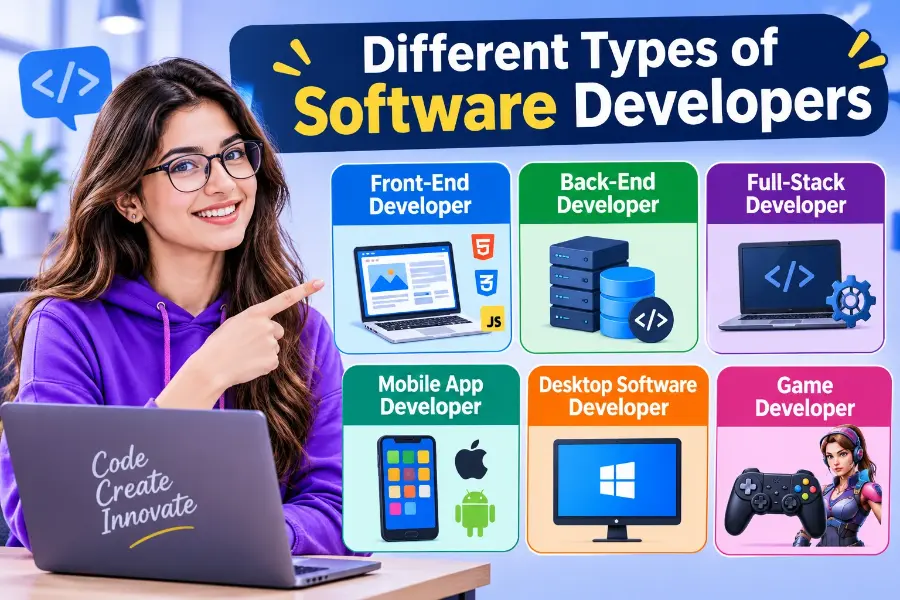
Here are six software developer types:
Front-End Developer
A front-end developer creates the parts of a website or application that users can see and interact with. These professionals focus on page layouts, navigation, buttons, menus, and other visual elements.
They commonly use HTML, CSS, and JavaScript to build attractive and responsive websites.
Back-End Developer
A back-end developer works on the server-side features that make applications function properly. Their responsibilities include managing databases, processing information, handling user accounts, and building application programming interfaces (APIs).
Common technologies include Python, Java, PHP, JavaScript with Node.js, and SQL.
Full-Stack Developer
A full-stack developer works on both the front end and back end of an application. They understand how the user interface, server, and database work together.
This role requires knowledge of multiple programming languages, development tools, and software technologies.
Mobile App Developer
A mobile app developer creates applications for smartphones and tablets. These applications may support shopping, communication, entertainment, education, or business activities.
Developers often use Swift for iOS development and Kotlin for Android development. Cross-platform tools such as Flutter and React Native are also popular options.
Desktop Software Developer
A desktop software developer creates programs that run on desktop and laptop computers. Examples include accounting software, photo editing programs, office applications, and business management systems.
These developers may use programming languages such as C#, Java, C++, and Python.
Game Developer
A game developer creates video games for computers, consoles, and mobile devices. They work on game mechanics, graphics, character movements, user interactions, and performance.
Common tools and technologies include Unity, Unreal Engine, C#, and C++.
How to Become a Software Developer: 9-Step Guide
Starting a software development career requires patience, regular practice, and a willingness to learn new technologies. The following nine steps can help beginners understand the process and prepare for their first development job.

Here are steps on how to become a Software Developer:
Step 1: Understand the Basics of Software Development
Before learning programming languages, take some time to understand what software development involves. Learn how computers work, how applications process information, and how developers use code to create digital products.
Start by exploring basic concepts such as:
- Programming: Writing instructions that computers can understand and execute.
- Algorithms: Following a series of steps to solve a particular problem.
- Data structures: Organizing and storing information so programs can use it efficiently.
- Software development life cycle: Understanding the stages involved in planning, creating, testing, and maintaining software.
- Debugging: Finding and correcting errors in computer programs.
You do not need advanced technical knowledge at this stage. Focus on understanding the basic concepts and how they connect to real software applications.
Step 2: Choose a Programming Language
Learning a programming language is one of the most important steps in becoming a software developer. A programming language lets you give instructions to a computer and create different types of applications.
Beginners should start with one language instead of trying to learn several at once.
Some popular programming languages include:
- Python: A beginner-friendly language used in web development, automation, data analysis, and artificial intelligence.
- JavaScript: Commonly used to create interactive websites and web applications.
- Java: Used in enterprise applications, backend systems, and Android development.
- C++: Commonly used in game development, system programming, and performance-focused applications.
- C#: Used for Windows applications, enterprise software, and game development.
Choose a language based on your career interests. For example, Python is a good starting point for general programming, while JavaScript is useful if you want to build websites.
After learning the fundamentals, practice writing small programs and gradually move toward more challenging projects.
Step 3: Learn Data Structures and Algorithms
Programming languages help you write code, but understanding data structures and algorithms helps you solve problems efficiently.
Data structures organize information so that programs can store, access, and manage it. Algorithms provide step-by-step methods for completing specific tasks.
Important topics to study include:
- Arrays and lists
- Strings
- Linked lists
- Stacks and queues
- Trees and graphs
- Sorting and searching algorithms
- Basic problem-solving techniques
- Time and space complexity
You do not need to master every advanced topic before building your first application. Start with basic concepts and practice solving simple programming problems.
These skills can also help you prepare for technical interviews, where employers may ask candidates to solve coding challenges.
Step 4: Get the Right Education or Training
Education can help you develop a strong foundation in computer science and software development. You can choose a traditional university degree, a technical training program, or online learning based on your budget and career goals.
Common educational options include:
Bachelor’s Degree in Computer Science
A computer science degree covers programming, algorithms, databases, computer systems, and other important technical subjects. It is a common pathway to software development roles.
Bachelor’s Degree in Software Engineering
A software engineering degree focuses on designing, developing, testing, and maintaining software systems. Students learn programming alongside software design, project management, and quality assurance.
Online Courses and Coding Bootcamps
Online courses and coding bootcamps offer practical training in programming languages and development tools. They can be useful for people who want to learn specific skills without completing a traditional degree.
When choosing a training program, look for one that includes practical exercises, real projects, and opportunities to practice coding.
Step 5: Learn Essential Development Tools
Professional software developers use different tools to write, organize, test, and manage their code. Learning these tools can make your work more efficient and help you prepare for real development environments.
Start with the following tools:
- Visual Studio Code: A popular code editor used for writing and managing programs.
- Git: A version control system that tracks changes in code.
- GitHub: A platform where developers store code, manage projects, and collaborate.
- Command Line: A text-based interface used to run development commands and perform tasks.
- Database Management Tools: Software used to create, organize, and manage application data.
- Debugging Tools: Tools that help identify and correct programming errors.
You do not need to learn every available development tool. Start with a code editor, Git, and GitHub, then explore other tools as your projects grow more complex.
Step 6: Build Real-World Software Projects
Practical experience is essential for becoming a capable software developer. Reading programming tutorials can teach you concepts, but building projects helps you understand how to apply those concepts.
Start with small projects that match your current skill level. As your knowledge grows, move on to applications with more features.

Some beginner-friendly project ideas include:
- Calculator Application: Create a simple calculator that performs basic mathematical operations.
- To-Do List: Build an application that allows users to add, edit, and delete tasks.
- Personal Website: Create a website that introduces your background, skills, and projects.
- Weather Application: Develop an application that displays weather information using an API.
- Expense Tracker: Build a program that records expenses and calculates spending totals.
- Student Management System: Create a basic application for managing student information and records.
Try to understand every part of the code you write. Avoid simply copying projects without learning how they work.
Completing several useful projects will help you improve your programming skills and show potential employers what you can do.
Step 7: Create a Professional Portfolio
A software developer portfolio is a collection of projects that demonstrates your technical skills and practical experience. It helps employers understand what you can build and how you approach programming problems.
Create a personal portfolio website and include links to your projects, GitHub repositories, and professional contact information.
A good portfolio should include:
- A short professional introduction.
- Your programming languages and technical skills.
- Three to five completed projects.
- Screenshots or demonstrations of your applications.
- Links to your source code on GitHub.
- A professional resume and contact information.
For each project, explain what it does, which technologies you used, and what problems you solved while developing it.
Keep your portfolio updated as you complete new projects. A well-organized portfolio can help you stand out when applying for internships and entry-level software development positions.
Step 8: Gain Practical Experience Through Internships or Freelancing
Practical experience helps you understand how software development works outside the classroom or on personal projects. It also gives you opportunities to improve your communication, teamwork, and technical skills.
Consider the following ways to gain experience:
- Internships: Apply for software development internships to learn from experienced professionals.
- Freelancing: Complete small programming projects for clients and build a record of practical work.
- Open-Source Projects: Contribute to public software projects and collaborate with other developers.
- Personal Projects: Continue creating applications that solve everyday problems.
- Volunteer Work: Help nonprofit organizations or small businesses with their technology needs.
Don’t wait until you feel like an expert to seek practical opportunities. Start with projects that match your current abilities and gradually take on more responsibility.
Step 9: Apply for Entry-Level Software Developer Jobs
Once you have developed your programming skills, completed projects, and prepared a portfolio, you can begin applying for entry-level positions.
Some suitable job titles include:
- Junior Software Developer
- Junior Web Developer
- Associate Software Developer
- Entry-Level Programmer
- Junior Front-End Developer
- Junior Back-End Developer
- Software Development Intern
Before applying, prepare a professional resume that highlights your education, programming languages, technical skills, and completed projects.
Also prepare for technical interviews. Employers may ask questions about programming fundamentals, data structures, algorithms, and problem-solving.
Practice explaining how your projects work and what challenges you faced during development.
Apply for positions that match your current experience, and don’t get discouraged by rejections. Use feedback and interview experience to improve your skills and application materials.
What Education Do You Need to Become a Software Developer?
The education required to become a software developer depends on the employer, job position, and type of software you want to develop.
Many employers prefer candidates with a bachelor’s degree in computer science, software engineering, or a related field. However, some employers also consider applicants with relevant programming skills, practical experience, certifications, and strong project portfolios.
Here are some common education pathways.
Bachelor’s Degree in Computer Science
A bachelor’s degree in computer science is one of the most recognized educational pathways for aspiring software developers.
Students usually study:
- Programming languages
- Computer architecture
- Data structures and algorithms
- Database management
- Operating systems
- Software development principles
- Computer networks
- Artificial intelligence fundamentals
This degree can provide a strong foundation for different technology careers, including software development, systems programming, and application development.
Software Engineering Degree
A software engineering degree focuses on the complete process of creating and maintaining software applications.
Students learn how to plan software projects, design application systems, write code, test programs, and manage software quality.
This degree may also cover teamwork, software documentation, project management, and development methodologies.
Online Courses and Coding Bootcamps
Online courses and coding bootcamps provide another way to learn software development. They are especially useful for people who want flexible learning schedules or practical training in a specific technology.
You can find courses covering:
- Python programming
- JavaScript development
- Web application development
- Java programming
- Mobile app development
- Database management
- Software testing
Choose courses with hands-on exercises and practical projects, not just video lessons.
Can You Become a Software Developer Without a Degree?
Yes, you can become a software developer without a traditional university degree. Many people learn programming through online courses, self-study, coding bootcamps, and practical experience.
However, the process requires discipline and consistent effort. You must develop the technical skills employers expect and demonstrate them through completed projects.
If you do not have a degree, focus on:
- Learning at least one programming language well.
- Understanding programming fundamentals and problem-solving.
- Building a portfolio with practical applications.
- Learning development tools such as Git and GitHub.
- Gaining experience through internships, freelance work, or open-source contributions.
- Preparing for technical interviews.
Remember that some employers require a bachelor’s degree, so your available job opportunities may depend on the company’s hiring requirements and your qualifications.
Essential Skills Needed to Become a Software Developer
Software developers need a combination of technical knowledge and personal skills to create reliable applications and work effectively with other professionals.
Developing these abilities can help you build confidence and succeed in your career.
Technical Skills
Technical skills are the practical abilities required to design, build, test, and maintain software.
Important technical skills include:
- Programming: Writing and organizing code in programming languages.
- Problem-Solving: Finding solutions to technical challenges.
- Data Structures and Algorithms: Organizing information and developing efficient solutions.
- Database Management: Storing, retrieving, and managing information.
- Version Control: Tracking code changes and collaborating through tools such as Git.
- Software Testing: Checking applications to identify errors and improve reliability.
- Debugging: Finding and correcting problems in programs.
The specific technical skills you need will depend on your chosen specialization.
Problem-Solving and Analytical Skills
Software development involves solving problems regularly. Developers must understand what an application needs to do and determine the best way to achieve that goal.
Strong analytical skills help you break complicated problems into smaller tasks, identify possible solutions, and choose an effective approach.
You can improve these skills by practicing coding challenges, studying algorithms, and building applications.
Communication and Teamwork Skills
Software developers often work with designers, project managers, clients, and other technical professionals.
Good communication helps them understand project requirements, explain technical problems, and share ideas with team members.
Teamwork is also important because many software projects require contributions from several professionals.
Attention to Detail and Creativity
Small coding mistakes can cause applications to behave incorrectly. Developers need attention to detail when writing, reviewing, and testing their programs.
Creativity is equally important because software development often involves finding new ways to solve problems and improve existing products.
Combining creativity with technical knowledge can help you build useful and user-friendly applications.
Best Programming Languages for Beginners
Choosing the right programming language can make your learning journey easier. Different languages serve different purposes, so the best option depends on the type of software you want to create.
Here are five popular programming languages worth considering.
Python
Python is widely used in general programming, web development, automation, data analysis, and artificial intelligence.
Its relatively readable syntax makes it a popular choice for beginners. It can also help you learn programming fundamentals before moving toward more advanced technologies.
JavaScript
JavaScript is an important language for web development. It allows developers to create interactive websites and web applications.
It is commonly used alongside HTML and CSS for front-end development. With tools such as Node.js, JavaScript can also be used for back-end development.
Java
Java is a widely used programming language for enterprise applications, business systems, and Android development.
It supports object-oriented programming and helps developers create applications that can run across different computing environments.
C++
C++ is a powerful programming language used in game development, system programming, and performance-focused applications.
It provides greater control over memory and system resources, but beginners may find it more challenging than Python or JavaScript.
C#
C# is commonly used to build Windows applications, business software, and games through the Unity game development platform.
It is a useful option for people interested in application development and game programming.
Beginner tip: Choose one programming language and learn its fundamentals before moving to another. Building a strong foundation is more valuable than learning several languages without understanding them properly.
How Long Does It Take to Become a Software Developer?
The time required to become a software developer depends on your education, learning schedule, programming experience, and career goals.
Someone who already understands programming may progress faster than a complete beginner. Similarly, someone studying full-time may learn faster than someone practicing only a few hours each week.
Here is a general learning timeline:
| Learning Stage | Estimated Time |
|---|---|
| Understanding programming basics | 1–3 months |
| Learning a programming language | 2–4 months |
| Studying data structures and algorithms | 2–4 months |
| Building practical projects | 2–4 months |
| Preparing for entry-level jobs | 1–3 months |
These stages can overlap, so the total learning time will vary.
People following a focused self-study plan may be ready to apply for some junior positions in about 6–18 months. A traditional bachelor’s degree usually takes around four years in the United States, although program lengths vary by country and institution.
Remember that becoming job-ready is different from becoming an experienced developer. Software development is a continuous learning process, and professionals keep improving their skills throughout their careers.
How Much Does a Software Developer Earn?
Software developers can earn competitive salaries, but their income depends on several factors, including experience, education, location, specialization, employer, and technical skills.
According to the U.S. Bureau of Labor Statistics (BLS), the median annual wage for software developers was $135,980 in May 2025.
This figure represents the U.S. labor market and should not be treated as a worldwide salary estimate.
Entry-Level Software Developer Salary
Entry-level software developers generally earn less than experienced professionals because they are still developing their technical knowledge and practical experience.
Their salaries may depend on:
- Programming languages they know.
- Education and professional qualifications.
- Quality of their project portfolio.
- Location and employer.
- Previous internships or work experience.
Developers who demonstrate strong problem-solving skills and practical programming knowledge may improve their career opportunities over time.
Experienced Software Developer Salary
Experienced software developers may earn higher salaries because they can manage complex projects, solve difficult technical problems, and contribute to important software systems.
Senior developers may also take on additional responsibilities, such as:
- Leading development teams.
- Reviewing and improving code.
- Designing software architecture.
- Managing technical projects.
- Mentoring junior developers.
- Making important development decisions.
Specialized knowledge in areas such as cloud computing, cybersecurity, artificial intelligence, and large-scale application development may also influence earning potential.
Factors That Affect Software Developer Salaries
Several factors can influence how much a software developer earns.
1. Experience: Developers with more professional experience often qualify for higher-paying positions.
2. Location: Salaries vary between countries, cities, and regional technology markets.
3. Technical Skills: Knowledge of in-demand programming languages, frameworks, and development tools can improve job opportunities.
4. Education: Some employers offer more opportunities to candidates with relevant university degrees or professional qualifications.
5. Industry: Software developers working in finance, technology, healthcare, and other specialized industries may receive different compensation packages.
6. Job Responsibilities: Senior developers and technical leads often earn more because they handle additional responsibilities.
For accurate salary information, compare job listings and official labor statistics for your country.
Career Opportunities and Job Outlook for Software Developers
Software development offers career opportunities across many industries. Businesses, government agencies, educational institutions, and technology companies depend on software to manage information and deliver digital services.
According to the U.S. Bureau of Labor Statistics, employment of software developers, quality assurance analysts, and testers is projected to grow 10% from 2025 to 2035. This is faster than the average projected growth for all occupations.
However, these projections cover a combined occupational group and relate specifically to the United States.
Some career opportunities available to software development professionals include:
- Software Developer: Designs and develops computer applications and programs.
- Web Developer: Creates and maintains websites and web applications.
- Mobile App Developer: Builds applications for smartphones and tablets.
- Back-End Developer: Develops server-side systems and application functionality.
- Full-Stack Developer: Works on both front-end and back-end development.
- Software Engineer: Applies engineering principles to designing and maintaining software systems.
- Game Developer: Creates interactive video games.
- Software Development Team Lead: Guides development teams and manages technical work.
As you gain experience, you may also move into software architecture, technical management, or specialized technology roles.
Tips for Becoming a Successful Software Developer
Learning programming is only the beginning. To build a successful career, you should develop good learning habits, practice regularly, and stay updated with changing technologies.
Here are some practical tips:
- Practice coding every day: Regular practice helps you understand programming concepts and improve your problem-solving abilities.
- Start with small projects: Build simple applications before attempting complicated software systems.
- Focus on fundamentals: Understand programming logic, data structures, algorithms, and debugging.
- Learn from documentation: Official documentation helps you understand how programming languages and development tools work.
- Use GitHub: Store your projects and demonstrate your coding progress.
- Ask for feedback: Share your work with experienced developers and learn from their suggestions.
- Improve communication skills: Clear communication helps you work effectively with clients and development teams.
- Stay updated: Follow technology developments and learn tools relevant to your career goals.
- Keep learning: Software development changes regularly, so continuous learning is important.
Most importantly, do not compare your progress with experienced developers. Focus on improving your own skills and completing projects one step at a time.
Is Software Development a Good Career Choice?
Software development can be a rewarding career for people who enjoy technology, logical thinking, and solving problems. It offers opportunities to work in different industries and develop a variety of technical specializations.
One major advantage is the flexibility of career options. You can work in web development, mobile application development, game development, enterprise software, or other technology fields.
Other potential benefits include:
- Opportunities to work with modern technologies.
- Career growth through experience and specialization.
- Opportunities for remote work with suitable employers.
- The ability to create useful products and applications.
- Opportunities for freelance work and independent projects.
- Demand for software skills across different industries.
However, the career also comes with challenges. Developers must spend time learning new technologies, solving complicated problems, meeting project deadlines, and fixing software errors.
If you enjoy learning, building digital products, and working through technical challenges, software development may be a suitable career path.
FAQs
Here are some common questions about becoming a software developer.
Software development can be challenging, especially when you are learning programming for the first time. However, beginners can make progress by studying the fundamentals and practicing regularly.
- Start with simple concepts: Learn the basics of programming, variables, functions, and problem-solving.
- Practice regularly: Write small programs and gradually build more advanced projects.
With patience and consistent practice, you can develop the skills needed to pursue this career.
Yes, you can become a software developer without a traditional university degree. Some employers consider candidates based on their technical skills, practical experience, and project portfolios.
- Learn programming: Study a language such as Python or JavaScript.
- Build a portfolio: Create projects that demonstrate your coding abilities.
However, some employers require a bachelor’s degree, so check the qualifications listed in job advertisements.
The time depends on your learning method, previous experience, and career goals. Some people become ready to apply for junior positions within 6–18 months of focused learning.
- Self-study: You may develop job-ready skills within several months to a few years.
- University education: A bachelor’s degree commonly takes around four years in the United States.
Your actual timeline will depend on how consistently you study and practice.
Python and JavaScript are popular starting options for beginners. The best choice depends on the type of software you want to develop.
- Python: Useful for general programming, automation, and data-related work.
- JavaScript: A good choice for people interested in website and web application development.
Choose one language and focus on understanding its fundamentals before learning another.
Software developers need some mathematical and logical thinking skills, but the amount of mathematics required depends on their specialization.
- Basic programming: Arithmetic, logical thinking, and problem-solving are useful.
- Specialized development: Fields such as game development, graphics programming, and machine learning may require more advanced mathematics.
You don’t need to be a mathematics expert to start learning software development.
Yes, online learning can help you develop the programming knowledge and technical skills required for software development.
- Online courses: Learn programming languages, development tools, and software concepts.
- Practical projects: Apply your knowledge by creating applications and building a portfolio.
Choose structured learning resources and practice consistently rather than relying only on watching tutorials.
Qualifications vary by employer and job position. Many companies prefer candidates with a computer science or software engineering degree, while others consider practical skills and experience.
- Educational qualifications: A relevant bachelor’s degree can provide a strong foundation.
- Technical qualifications: Programming knowledge, project experience, and problem-solving skills are important.
Always review the specific requirements of the positions you want to pursue.
Yes, you can apply for entry-level software development positions without professional experience. However, you should demonstrate your abilities through personal projects and practical training.
- Build projects: Create applications that show your programming knowledge.
- Apply for junior roles: Look for internships, trainee positions, and entry-level developer jobs.
A strong portfolio can help employers understand your abilities even with limited professional experience.
Becoming a software developer takes time, practice, and continuous learning. Start with the basics, build useful projects, and gradually develop the skills needed for your chosen career path.
You May Also Like
1. How to Become a Web Developer
Interested in building websites and web applications? Explore the skills, programming languages, education, and practical steps needed to start a career in web development.
2. How to Become a Data Analyst
Learn how to start a career in data analytics, develop technical skills, work with data tools, and explore job opportunities in this growing field.
3. How to Become a Computer Programmer
Discover how to learn programming, choose the right coding languages, improve problem-solving skills, and prepare for programming jobs.
How to Become a Computer Programmer
Conclusion
Learning how to become a software developer starts with understanding programming fundamentals and choosing a suitable learning path. You can pursue a computer science degree, study software engineering, or develop your skills through online courses and practical projects.
Focus on learning one programming language, understanding data structures and algorithms, and becoming comfortable with essential development tools. Build a portfolio, gain practical experience, and prepare for entry-level job opportunities.
You do not have to become an expert overnight. Set realistic goals, practice consistently, and keep improving your technical knowledge. With dedication and the right preparation, you can work toward building a successful career in software development.
References
- U.S. Bureau of Labor Statistics – Software Developers, Quality Assurance Analysts, and Testers
- MDN Web Docs – Learn Web Development

How to Become a Wind Turbine Technician: Education, Training, Salary, and Career Outlook



- Be Respectful
- Stay Relevant
- Stay Positive
- True Feedback
- Encourage Discussion
- Avoid Spamming
- No Fake News
- Don't Copy-Paste
- No Personal Attacks
- Be Respectful
- Stay Relevant
- Stay Positive
- True Feedback
- Encourage Discussion
- Avoid Spamming
- No Fake News
- Don't Copy-Paste
- No Personal Attacks
