Scientific Careers Salary Guide: Pay, Skills, and Opportunities
Published: 6 Oct 2026
Scientific careers offer exciting opportunities for people interested in research, technology, healthcare, and environmental science. However, understanding earning potential is an important part of choosing the right profession. This Scientific Careers Salary Guide explores salary expectations across different scientific fields, helping students and professionals make informed career decisions.
Salaries can vary significantly between professions, from biotechnology and data science to microbiology and environmental research. Education, work experience, specialized skills, industry, and geographic location all influence how much a scientific professional can earn.
Whether you are starting your career or considering a professional change, understanding salary trends and future opportunities can help you identify a scientific career that matches your interests, qualifications, and financial goals.
What Is a Scientific Careers Salary Guide?
A Scientific Careers Salary Guide helps students, recent graduates, and experienced professionals understand the earning potential of different science-related professions. It provides information about salary ranges, educational requirements, essential skills, job responsibilities, and career growth opportunities, making it easier to compare scientific career paths before making an important career decision.
Scientific careers cover a wide range of fields, including biotechnology, data science, microbiology, chemistry, environmental science, biomedical research, and genetics. Each field offers different earning opportunities depending on the work, required expertise, employer, and demand for specialized knowledge.
How Salary Guides Help You Compare Scientific Careers
A reliable salary guide helps you evaluate more than just a job’s starting pay. It allows you to compare several important factors:
- Salary ranges: Understand typical entry-level, mid-career, and experienced professional earnings.
- Education and qualifications: Identify the degrees, certifications, and specialized training required for different scientific roles.
- Required skills: Discover the technical, analytical, laboratory, research, and digital skills employers value.
- Career advancement: Learn how additional experience, advanced qualifications, and specialization may lead to senior positions and higher earnings.
- Job opportunities: Compare employment prospects across industries such as healthcare, pharmaceuticals, biotechnology, government research, and environmental consulting.
Why Salary Ranges and Career Growth Matter
Scientific professionals do not all earn the same salary, even when they work in similar fields. For example, a research assistant may earn less than a senior research scientist because of differences in experience, responsibilities, and qualifications. Similarly, specialized positions in biotechnology, bioinformatics, and pharmaceutical research may offer different compensation from academic or laboratory-based roles.
When comparing salaries, consider the median salary, entry-level pay, and experienced-worker earnings rather than relying on a single advertised figure. The median represents the midpoint of a salary distribution, while a salary range shows the variation in earnings. These figures become more useful when supported by reliable data for a specific country and year.
Also consider the cost of education, professional development, and the time required to qualify for a role. A career with a lower starting salary may still offer strong long-term opportunities through specialization, promotion, or a move into industry.
Ultimately, a Scientific Careers Salary Guide helps you balance earning potential, qualifications, job demand, and long-term career growth. By comparing these factors together, you can make a more informed decision about which scientific profession best fits your skills, interests, and financial goals.
Top Scientific Careers and Their Salaries
Scientific careers offer opportunities in healthcare, biotechnology, environmental protection, data analysis, and laboratory research. Each profession has different educational requirements, responsibilities, and earning potential. Understanding these differences can help students, graduates, and professionals choose a career that matches their interests and long-term goals.
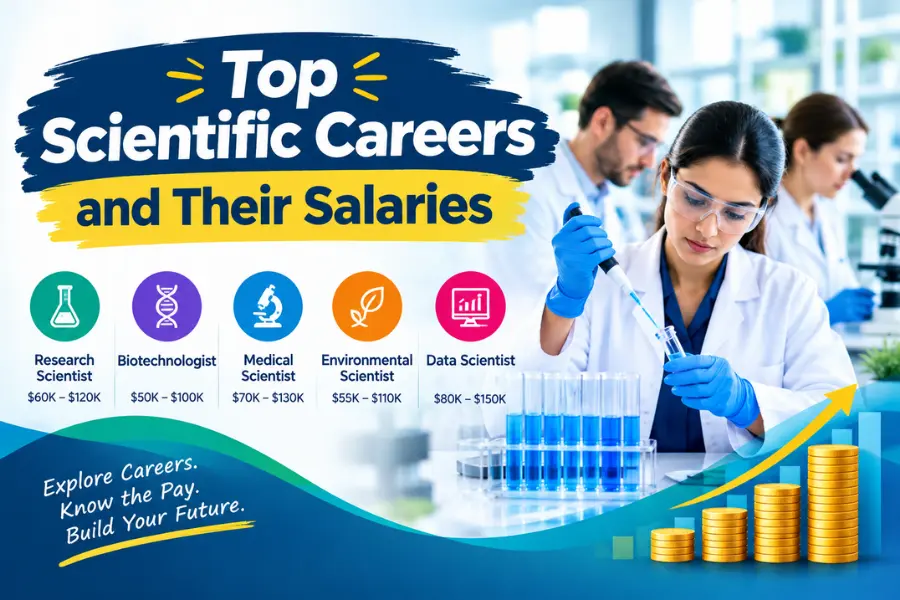
The following Scientific Careers Salary Guide highlights ten scientific professions, including their typical responsibilities, qualifications, salary potential, and career opportunities. Salary figures are based on U.S. national median annual wages reported by the U.S. Bureau of Labor Statistics (BLS) for May 2025. These figures represent established occupations, not guaranteed starting salaries.
Data Scientist
A data scientist uses statistics, programming, and analytical techniques to turn complex data into useful insights. Data scientists work across industries, including healthcare, biotechnology, finance, technology, and scientific research. They help organizations identify patterns, evaluate results, build predictive models, and make evidence-based decisions.
Salary: The median annual salary for data scientists in the United States was $120,230 in May 2025. The lowest 10% earned less than $67,240, while the highest 10% earned more than $199,130. Actual earnings depend on experience, technical expertise, industry, and location. Source: U.S. Bureau of Labor Statistics.
Education and skills: A bachelor’s degree in data science, statistics, mathematics, computer science, or a related field is a common entry route. Employers may prefer advanced degrees for specialized positions. Important skills include Python, SQL, statistical analysis, data visualization, and machine learning.
Career opportunities: Data scientists can advance into senior data science, machine learning, analytics management, and research-focused positions. Combining programming skills with scientific knowledge can be particularly valuable in healthcare and biotechnology.
Biotechnologist
A biotechnologist applies biological knowledge and technology to develop or improve products, processes, and services. Biotechnology professionals may work in pharmaceutical development, agricultural research, genetic engineering, industrial biotechnology, and laboratory testing.
Salary: Earnings vary widely according to specialization and job responsibilities. For a related U.S. benchmark, biochemists and biophysicists earned a median annual salary of $127,410 in May 2025. This figure is a comparison point, not a direct salary estimate for all biotechnologists. Source: U.S. Bureau of Labor Statistics.
Education and skills: A bachelor’s degree in biotechnology, molecular biology, biochemistry, or a related discipline can qualify candidates for some laboratory and industry positions. Research-intensive roles may require a master’s degree or Ph.D. Relevant skills include molecular biology, cell culture, laboratory techniques, data interpretation, and quality control.
Career opportunities: Potential pathways include biotechnology research, pharmaceutical production, quality assurance, bioprocess development, and regulatory affairs. Advanced research positions may offer greater responsibility and earning potential.
Biomedical Scientist
A biomedical scientist studies biological processes and diseases to improve the understanding, diagnosis, prevention, and treatment of health conditions. Depending on the country and job title, the role may involve laboratory diagnostics, medical research, clinical laboratory testing, or developing new treatments.
Salary: No single salary figure applies to every biomedical scientist because the title covers different occupations in different countries. As a related U.S. benchmark, medical scientists earned a median annual salary of $103,410 in May 2025. This figure applies to the BLS medical scientist occupation, not every diagnostic laboratory role. Source: U.S. Bureau of Labor Statistics.
Education and skills: Relevant qualifications include biomedical science, biology, biochemistry, or a related life science. Diagnostic laboratory roles may require additional accreditation or professional registration, depending on the country. Research positions may require postgraduate education. Important skills include laboratory analysis, research methods, scientific documentation, and knowledge of biological processes.
Career opportunities: Biomedical scientists may pursue careers in diagnostic laboratories, hospitals, pharmaceutical companies, universities, and medical research institutions. Specialized expertise and advanced qualifications can support progression into senior laboratory, research, or management roles.
Environmental Scientist
An environmental scientist investigates environmental conditions and develops solutions to problems involving pollution, waste, water quality, soil contamination, and natural resource management. These professionals help businesses, government agencies, and communities understand environmental risks and comply with relevant regulations.
Salary: The median annual salary for environmental scientists and specialists in the United States was $82,220 in May 2025. The lowest 10% earned less than $52,520, while the highest 10% earned more than $140,010. Source: U.S. Bureau of Labor Statistics.
Education and skills: A bachelor’s degree in environmental science, environmental biology, chemistry, geology, or a related discipline is a common requirement. Useful skills include environmental sampling, geographic information systems (GIS), data analysis, environmental assessment, and scientific report writing.
Career opportunities: Environmental scientists can work in consulting, government, conservation, energy, environmental compliance, and sustainability. Experience in environmental regulations, impact assessments, and specialized analytical methods can support career advancement.
Research Scientist
A research scientist designs experiments, analyzes evidence, and develops new knowledge within a scientific discipline. Depending on the field, research scientists may investigate diseases, test new materials, study biological systems, or develop innovative technologies.
Salary: Research scientist salaries vary substantially by specialization. As one relevant U.S. benchmark, medical scientists earned a median annual salary of $103,410 in May 2025. This figure reflects medical scientists, not all types of research scientists. Source: U.S. Bureau of Labor Statistics.
Education and skills: A bachelor’s degree may support entry into laboratory assistant or research technician positions. Independent research scientist roles often require a master’s degree or Ph.D., depending on the discipline and employer. Important skills include experimental design, critical thinking, statistical analysis, scientific writing, and research ethics.
Career opportunities: Research scientists may work at universities, government laboratories, pharmaceutical companies, private research organizations, and industrial research facilities. With experience, they can advance to senior research, project leadership, laboratory management, or research director roles.
Food Scientist
A food scientist studies food composition, processing, preservation, quality, and safety. These professionals help manufacturers develop products, improve shelf life, maintain consistent quality, and meet food safety standards. Their work may also involve nutritional analysis and developing new food ingredients.
Salary: The median annual salary for food scientists and technologists in the United States was $88,720 in May 2025. The figure is a national occupational median and does not represent the starting salary for every food science position. Source: U.S. Bureau of Labor Statistics.
Education and skills: A bachelor’s degree in food science, food technology, chemistry, microbiology, or a related field is a common entry requirement. Valuable skills include food testing, quality assurance, product development, microbiological analysis, and knowledge of food safety regulations.
Career opportunities: Food scientists can work in food manufacturing, product development, research laboratories, quality management, and regulatory compliance. Experience in food safety systems, product innovation, and production processes can open pathways to senior technical and managerial roles.
Microbiologist
A microbiologist studies microorganisms, including bacteria, fungi, algae, and other microscopic life forms. Their work supports medical research, pharmaceutical development, food safety, public health, agriculture, and environmental monitoring.
Salary: The median annual salary for microbiologists in the United States was $87,990 in May 2025. The lowest 10% earned less than $54,670, while the highest 10% earned more than $150,000. Source: U.S. Bureau of Labor Statistics.
Education and skills: A bachelor’s degree in microbiology or a related biological science is a common entry requirement. Some research positions prefer a master’s degree or Ph.D. Important skills include aseptic technique, microbial culture, microscopy, laboratory safety, and molecular testing.
Career opportunities: Microbiologists can work in pharmaceutical manufacturing, medical research, food testing, environmental laboratories, and public health organizations. Specialization in molecular microbiology, industrial microbiology, or quality control may help professionals access more advanced roles.
Genetic Scientist
A genetic scientist studies genes, heredity, DNA, and genetic variation. These professionals contribute to research into inherited conditions, agricultural improvement, biotechnology, and the biological mechanisms underlying disease. Their work may involve analyzing genetic data, conducting molecular experiments, or investigating how genes influence biological characteristics.
Salary: Genetic science includes several distinct occupations, so a single median salary would be misleading. For a related U.S. benchmark, biochemists and biophysicists earned a median annual salary of $127,410 in May 2025. This figure does not directly apply to genetic scientists or genetic counselors. Source: U.S. Bureau of Labor Statistics.
Education and skills: Relevant degrees include genetics, molecular biology, genomics, biotechnology, and biochemistry. Research-intensive positions often require postgraduate study. Useful skills include DNA sequencing, molecular biology techniques, bioinformatics, statistical analysis, and interpreting scientific data.
Career opportunities: Genetic scientists may work in genomics laboratories, universities, biotechnology companies, pharmaceutical research, and agricultural research. Expertise in genomic analysis and computational biology can expand opportunities in specialized research roles.
Chemist
A chemist studies the composition, properties, and reactions of substances. Chemists develop and test materials, analyze chemical samples, improve manufacturing processes, and contribute to research in pharmaceuticals, energy, food production, and environmental protection.
Salary: The median annual salary for chemists in the United States was $91,240 in May 2025. The lowest 10% earned less than $58,460, while the highest 10% earned more than $160,830. Source: U.S. Bureau of Labor Statistics.
Education and skills: A bachelor’s degree in chemistry or a related field is commonly required for entry-level positions. Advanced research roles may require a master’s degree or Ph.D. Important skills include analytical chemistry, laboratory instrumentation, quality testing, chemical safety, and experimental analysis.
Career opportunities: Chemists can pursue careers in pharmaceutical research, chemical manufacturing, environmental testing, materials development, and quality assurance. Specializing in analytical chemistry, medicinal chemistry, or advanced materials can help professionals advance into more specialized roles.
Forensic Scientist
A forensic scientist applies scientific methods to evidence used in criminal investigations and legal proceedings. Depending on their specialization, forensic scientists may examine biological samples, analyze chemical substances, investigate trace evidence, or work with DNA and other laboratory evidence.
Salary: The median annual salary for forensic science technicians in the United States was $72,060 in May 2025. The lowest 10% earned less than $48,250, while the highest 10% earned more than $117,250. These figures apply specifically to forensic science technicians, not all forensic specialists. Source: U.S. Bureau of Labor Statistics.
Education and skills: A bachelor’s degree in forensic science, chemistry, biology, or a related field is commonly required, though requirements vary by position. Key skills include evidence handling, laboratory analysis, accurate documentation, attention to detail, and the ability to clearly explain scientific findings.
Career opportunities: Forensic professionals may work in government laboratories, law enforcement agencies, forensic testing facilities, and specialized analytical laboratories. Experience and further training can support progression into senior analyst, laboratory supervisor, or specialist roles.
Scientific Careers Salary Comparison
Comparing salaries across scientific professions helps students, graduates, and experienced professionals understand their earning potential and career options. However, scientific career salaries depend on education, work experience, technical skills, employer, industry, and location.
To make an informed decision, it is important to understand the differences between entry-level salaries, mid-career earnings, and experienced professional salaries. Entry-level workers generally earn less as they develop practical skills, while experienced professionals may earn more through specialization, leadership responsibilities, and advanced qualifications.
The following comparison uses the United States as the reference market, with national median annual wages reported by the U.S. Bureau of Labor Statistics (BLS) for May 2025. Median salaries represent the midpoint of an occupation’s wage distribution, not guaranteed starting salaries.
Scientific Careers Salary Comparison Table
Here is the salary comparison table.
| Scientific Career | Typical Education | U.S. Median Annual Salary | Career Outlook |
|---|---|---|---|
| Data Scientist | Bachelor’s degree | $120,230 | Very strong; 35% projected growth |
| Biotechnologist* | Bachelor’s or advanced degree | $127,410* | Depends on specialization |
| Biomedical Scientist* | Advanced degree for many research roles | $103,410* | Varies by role |
| Environmental Scientist | Bachelor’s degree | $82,220 | Positive; 6% projected growth |
| Research Scientist* | Bachelor’s to Ph.D., depending on role | $103,410* | Varies by research field |
| Food Scientist* | Bachelor’s degree | $81,970* | Depends on specialization |
| Microbiologist | Bachelor’s degree | $87,990 | Varies by industry |
| Genetic Scientist* | Often advanced study for research roles | $127,410* | Depends on specialty |
| Chemist | Bachelor’s degree | $91,240 | Varies by industry |
| Forensic Science Technician | Bachelor’s degree | $72,060 | Positive; 13% projected growth |
Note: Salary figures are U.S. occupational benchmarks for May 2025. Biotechnologist, biomedical scientist, research scientist, and genetic scientist are broad job titles that do not map directly to a single BLS occupation. Their figures above use related occupations as reference points, not exact salaries for every role. The food scientist figure uses the agricultural and food scientists occupation.
Entry-Level vs. Mid-Career vs. Experienced Salaries
Salary progression varies by profession, employer, qualifications, and local job market. The following career stages provide a practical framework for understanding earning potential.
- Entry-level: Recent graduates typically begin in assistant, technician, trainee, or junior scientist positions. Salaries depend on qualifications, practical experience, and role responsibilities.
- Mid-career: Professionals with several years of experience may qualify for specialist positions, independent project responsibilities, and higher-paying industry roles.
- Experienced professionals: Senior scientists, principal investigators, technical leads, and laboratory managers may earn more because of their expertise, leadership responsibilities, and specialized skills.
For an accurate comparison, consult occupation-specific salary distributions rather than assuming that every profession follows the same salary progression. For example, in May 2025, U.S. data scientists earned less than $67,240 at the 10th percentile and more than $199,130 at the 90th percentile. These figures illustrate the range of earnings within the occupation; they are not exact entry-level and senior-level salaries.
Factors That Affect Scientific Career Salaries
Several important factors influence how much scientific professionals can earn:
- Education and qualifications: Advanced degrees may be necessary for independent research and specialized positions, although many technical roles accept bachelor’s degrees.
- Work experience: Practical expertise, project ownership, and leadership responsibilities can improve earning potential.
- Industry and employer: Pharmaceutical companies, biotechnology firms, government agencies, universities, and private laboratories may offer different compensation.
- Specialized skills: Bioinformatics, machine learning, genomic analysis, advanced laboratory techniques, and regulatory knowledge can help candidates qualify for specialized roles.
- Geographic location: Salaries vary by country, region, and city. Compare earnings alongside local living costs and employment opportunities.
Which Scientific Careers Offer Strong Earning Potential?
Among the occupations compared, data science has a relatively high median salary and strong projected employment growth in the United States. Specialized careers in biotechnology, genetics, and biomedical research can also offer attractive opportunities, although earnings depend on the specific position and qualifications required.
Environmental science and forensic science provide alternative career paths for people interested in environmental protection, public safety, and applied scientific investigation. Their salary potential and employment prospects differ from those of data science and laboratory research.
The best scientific career is not necessarily the one with the highest salary. Before choosing a profession, consider your interests, education costs, required qualifications, job availability, and long-term advancement opportunities.
Sources for Salary and Career Outlook Data
- U.S. Bureau of Labor Statistics: Data Scientists
- U.S. Bureau of Labor Statistics: Environmental Scientists and Specialists
- U.S. Bureau of Labor Statistics: Microbiologists
- U.S. Bureau of Labor Statistics: Chemists and Materials Scientists
- U.S. Bureau of Labor Statistics: Forensic Science Technicians
- U.S. Bureau of Labor Statistics: Medical Scientists
- U.S. Bureau of Labor Statistics: Biochemists and Biophysicists
- U.S. Bureau of Labor Statistics: Agricultural and Food Scientists
Always verify salary figures and projected employment growth against the latest official occupational data before publication and outlooks. However, the best career is not necessarily the one with the highest median salary. Consider your interests, educational investment, employment opportunities, and long-term advancement potential together.
Highest-Paying Scientific Careers
Choosing a scientific profession involves more than considering your interests; salary potential, specialized skills, education requirements, and long-term career growth also matter. Some scientific occupations offer particularly competitive earnings because they require advanced technical knowledge, specialized research experience, or expertise in fields such as data science, biotechnology, and medicine.
In the United States, the U.S. Bureau of Labor Statistics reported a median annual salary of $120,230 for data scientists and $127,410 for biochemists and biophysicists in May 2025. These figures illustrate the earning potential of selected scientific occupations, although salaries vary by employer, experience, location, and specialization.
1. Data Scientist
Data science is a strong option for professionals who enjoy mathematics, programming, statistics, and solving complex problems. Data scientists analyze large datasets to identify patterns, build predictive models, and support evidence-based decisions in industries such as healthcare, biotechnology, and scientific research.
- Median annual salary: $120,230 in the United States.
- Typical education: Bachelor’s degree in data science, statistics, mathematics, computer science, or a related field.
- High-value skills: Python, SQL, statistical modeling, machine learning, data visualization, and predictive analytics.
- Career advancement: Senior data scientist, machine learning specialist, analytics manager, or research scientist.
Employment of U.S. data scientists is projected to grow by 35% from 2025 to 2035, indicating strong expected demand for this occupation.
2. Biochemist and Biophysicist
Biochemistry and biophysics combine biology, chemistry, and physics to investigate living organisms and biological processes. Professionals in these fields may research diseases, develop medicines, study proteins, or investigate how cells and molecules function.
- Median annual salary: $127,410 in the United States.
- Typical education: A Ph.D. is generally required for independent research and development positions, although bachelor’s and master’s degree holders can qualify for certain entry-level roles.
- High-value skills: Molecular biology, laboratory research, biochemical analysis, experimental design, and scientific data interpretation.
- Career advancement: Senior research scientist, principal investigator, laboratory director, or research and development manager.
Biochemists and biophysicists are projected to grow 12% from 2025 to 2035. Specialized research expertise and experience in pharmaceutical development can improve access to advanced opportunities.
3. Medical Scientist
Medical scientists conduct research to improve human health, investigate diseases, and evaluate potential treatments. They may work in pharmaceutical companies, hospitals, universities, and scientific research organizations.
- Median annual salary: $103,410 in the United States.
- Typical education: A Ph.D. or another relevant advanced qualification is common for independent research roles.
- High-value skills: Clinical research methods, experimental design, biostatistics, laboratory techniques, and scientific writing.
- Career advancement: Senior medical researcher, clinical research lead, principal investigator, or research program director.
Employment of medical scientists is projected to grow by 13% from 2025 to 2035. Research experience, specialized knowledge, and the ability to manage complex projects can help professionals advance.
4. Physicist and Astronomer
Physicists and astronomers study matter, energy, space, and the fundamental principles that govern the universe. Their work can involve theoretical research, experimental physics, astronomy, advanced instrumentation, and developing scientific technologies.
- Median annual salary: Check the latest BLS occupational profile for the current median.
- Typical education: A Ph.D. is generally required for research positions in physics and astronomy, while some related technical roles accept bachelor’s or master’s degrees.
- High-value skills: Advanced mathematics, computational modeling, programming, data analysis, and experimental research.
- Career advancement: Senior researcher, research professor, laboratory scientist, or scientific program leader.
Advanced qualifications and expertise in computational physics, instrumentation, or specialized research methods can help candidates qualify for more senior roles. However, academic and research positions can be competitive.
5. Natural Sciences Manager
Natural sciences managers supervise scientific teams, coordinate research projects, manage budgets, and oversee laboratory or technical operations. They may work in biotechnology, pharmaceuticals, environmental science, manufacturing, and research institutions.
- Salary potential: This occupation can offer higher earnings than many individual scientific roles, depending on responsibility and employer.
- Typical education: A bachelor’s degree in a scientific discipline is common, together with substantial relevant work experience. Some positions prefer advanced degrees.
- High-value skills: Project management, scientific leadership, budgeting, communication, regulatory knowledge, and team supervision.
- Career advancement: Research director, laboratory director, head of scientific operations, or research and development executive.
Moving into management can improve earning potential, but it typically requires a combination of scientific expertise, practical experience, and leadership ability.
Qualifications and Skills That Can Increase Scientific Salaries
No qualification guarantees a high salary, but certain educational choices and professional skills can improve your competitiveness for specialized scientific roles.
1. Advanced education: A master’s degree or Ph.D. can be important for independent research, advanced laboratory positions, and specialist roles. However, the value of further education depends on the career path and the additional opportunities it provides.
2. Data analysis and programming: Skills in Python, R, SQL, statistical modeling, and machine learning are useful in data science, bioinformatics, computational biology, and research.
3. Specialized laboratory expertise: Experience with molecular biology, analytical chemistry, genomic sequencing, advanced instrumentation, and validated laboratory procedures can help professionals qualify for technical positions.
4. Industry experience: Practical experience through internships, research projects, laboratory placements, and industry employment helps demonstrate that you can apply scientific knowledge to real problems.
5. Project management and leadership: Scientists who can coordinate projects, supervise teams, manage budgets, and communicate findings may qualify for senior technical and management positions.
6. Regulatory and quality expertise: Knowledge of quality assurance, laboratory safety, research ethics, and relevant industry regulations can be valuable in pharmaceutical, biotechnology, food science, and medical research environments.
How to Choose a High-Paying Scientific Career
Before choosing a profession mainly for its earning potential, compare salary ranges, education costs, entry requirements, job availability, and long-term advancement opportunities. A career with a high median salary may require many years of postgraduate education, while another profession may provide an earlier route into paid employment.
Consider your strengths and interests. If you enjoy programming and mathematical analysis, data science may be a suitable option. If you prefer laboratory experiments and biological research, biochemistry or medical science may be a better match. If you enjoy leading teams and coordinating complex projects, scientific management could be a long-term goal.
Ultimately, the most suitable high-paying scientific career combines strong earning potential, relevant skills, realistic educational requirements, and sustainable career growth.
Entry-Level Scientific Careers and Salaries
Starting a scientific career does not always require years of advanced education or extensive professional experience. Many graduates start in entry-level scientific jobs, including laboratory assistant, biological technician, research assistant, quality control technician, and junior data scientist roles. These roles help new professionals develop practical skills, gain industry experience, and build a foundation for long-term career growth.
The best entry-level opportunity depends on your degree, technical skills, and preferred scientific field. Some positions focus on laboratory testing and sample preparation, while others involve research support, data analysis, environmental monitoring, or product quality testing.
Best Entry-Level Scientific Careers for Recent Graduates
1. Laboratory Assistant
A laboratory assistant supports scientists and laboratory teams by preparing samples, organizing equipment, maintaining records, and helping ensure that laboratory procedures are followed correctly. These positions are available in universities, hospitals, pharmaceutical companies, diagnostic laboratories, and research facilities.
- Typical qualifications: A relevant science degree, diploma, or laboratory training, depending on the employer.
- Essential skills: Sample handling, laboratory safety, equipment preparation, accurate recordkeeping, and attention to detail.
- Career growth: Laboratory technician, senior laboratory technician, or specialized laboratory professional.
2. Biological Technician
A biological technician assists biological and medical scientists with experiments, sample preparation, data collection, and laboratory testing. This role can be a practical starting point for graduates interested in microbiology, biotechnology, molecular biology, or biomedical research.
- Typical qualifications: A bachelor’s degree in biology or a related field is common.
- U.S. salary benchmark: The median annual wage was $57,510 in May 2025.
- Essential skills: Laboratory techniques, microscopy, sample preparation, scientific documentation, and data analysis.
- Career growth: Experienced technicians may advance to specialist or scientist positions, sometimes with additional education.
Source: U.S. Bureau of Labor Statistics — Biological Technicians.
3. Research Assistant
A research assistant helps scientists and academic teams conduct experiments, review scientific literature, collect data, and prepare research reports. Research assistants may work in university departments, biotechnology companies, medical research institutions, and government laboratories.
- Typical qualifications: A bachelor’s degree or current enrollment in a relevant degree program, depending on the position.
- Essential skills: Research methods, data collection, scientific writing, critical thinking, and experimental procedures.
- Career growth: Research associate, project coordinator, specialist researcher, or advanced research positions.
Some research roles are temporary or grant-funded, so candidates should review the contract length, funding arrangements, and professional development opportunities before accepting an offer.
4. Clinical Laboratory Assistant or Technician
Clinical laboratory professionals analyze biological specimens used to detect, diagnose, and monitor diseases. Their responsibilities may include preparing samples, operating laboratory equipment, maintaining records, and supporting laboratory testing.
- Typical qualifications: Requirements vary by country and position; some technician roles accept shorter postsecondary qualifications, while technologist roles often require a bachelor’s degree.
- Essential skills: Specimen handling, laboratory safety, quality control, accurate documentation, and knowledge of laboratory procedures.
- Career growth: Senior technician, specialized laboratory professional, or laboratory supervisor.
In the United States, clinical laboratory technologists and technicians had a median annual wage of $62,930 in May 2025. This figure covers the occupation overall, not just entry-level workers. Licensing or professional registration may also be required, depending on the location.
Source: U.S. Bureau of Labor Statistics — Clinical Laboratory Technologists and Technicians.
5. Food Science Technician
A food science technician supports food scientists in testing ingredients, evaluating product quality, checking food safety, and monitoring production processes. This position can suit graduates interested in food technology, chemistry, microbiology, or quality assurance.
- Typical qualifications: Requirements range from relevant technical qualifications to an associate’s or bachelor’s degree, depending on the employer.
- Essential skills: Food testing, sample preparation, quality control, laboratory documentation, and food safety procedures.
- Career growth: Quality assurance specialist, food laboratory technician, product development technician, or quality control supervisor.
The median annual wage for food science technicians in the United States was $52,130 in May 2025. This is an occupational median, not a guaranteed starting salary.
Source: U.S. Bureau of Labor Statistics — Agricultural and Food Science Technicians.
6. Junior Data Scientist
A junior data scientist supports data analysis projects by cleaning datasets, preparing reports, identifying patterns, and helping develop statistical or machine-learning models. This can be an attractive entry route for graduates with strong analytical and programming skills.
- Typical qualifications: A bachelor’s degree in data science, statistics, mathematics, computer science, or a related field.
- Essential skills: Python, SQL, statistics, data visualization, and basic machine learning.
- Career growth: Data scientist, machine learning specialist, senior analyst, or analytics manager.
Candidates without substantial data science experience may also consider junior data analyst, research data assistant, or scientific programming roles.
Entry-Level Scientific Salaries: What Should You Expect?
Entry-level salaries differ from occupational median wages. A median includes workers across the occupation, including those with considerable experience. Therefore, it shouldn’t be presented as what a new graduate can automatically expect to earn.
For a realistic salary estimate, compare recent job advertisements, official wage data, and employer requirements for your chosen location. Consider the following factors:
- Education: Some assistant and technician positions accept diplomas or bachelor’s degrees, while research-intensive roles may require postgraduate qualifications.
- Practical experience: Laboratory placements, internships, research projects, and relevant work experience can strengthen applications.
- Technical skills: Employers value practical knowledge of laboratory equipment, scientific software, data analysis, and quality procedures.
- Employer and industry: Universities, hospitals, pharmaceutical companies, manufacturers, and private laboratories may offer different pay and benefits.
- Location: Salaries and living costs vary substantially by country and city.
How Internships Help You Start a Scientific Career
A scientific internship provides practical exposure to professional research, laboratory operations, or industry projects. Internships help students and recent graduates understand workplace expectations and show they can apply academic knowledge.
Useful internship opportunities include:
- University research internships: Assist with experiments, literature reviews, data collection, and academic projects.
- Pharmaceutical and biotechnology internships: Learn about laboratory testing, product development, quality assurance, and manufacturing processes.
- Environmental science internships: Gain experience in environmental sampling, fieldwork, data analysis, and compliance.
- Food science internships: Learn about food safety, product testing, quality control, and production standards.
- Data science internships: Develop experience in programming, statistical analysis, data cleaning, and scientific modeling.
Before accepting an internship, check whether it is paid, how long it lasts, what training is provided, and whether you will receive meaningful supervision. An unpaid internship may not work for every graduate, so consider paid placements and entry-level employment as well.
How to Qualify for Your First Scientific Job
If you are a recent graduate, follow these practical steps to improve your chances of securing an entry-level scientific position:
- Choose a relevant job title: Search for positions such as laboratory assistant, research assistant, biological technician, quality control technician, or junior data analyst.
- Build practical skills: Gain experience with relevant lab techniques, scientific software, data analysis, safety procedures, and quality standards.
- Create a focused CV: Highlight your degree, laboratory coursework, final-year project, internships, technical skills, and research experience.
- Prepare a portfolio where relevant: Data science candidates can showcase analysis projects, while research candidates can describe projects and methods they have used.
- Apply to suitable employers: Explore universities, research centers, laboratories, pharmaceutical companies, environmental consultancies, and food manufacturers.
- Continue learning: Short courses and certifications can strengthen your profile when they match the target position and are recognized by employers.
Can entry-level scientific jobs lead to higher salaries?
Yes. Entry-level roles can lead to specialized and senior positions as professionals gain experience, build technical expertise, and take on greater responsibilities. For example, a biological technician may progress into specialized laboratory work or a scientist role after gaining experience or completing further education.
However, advancement is not automatic. Some scientific careers require postgraduate degrees, professional registration, or additional training. Before investing in further education, review the qualifications required for the positions you ultimately want to pursue.
Key takeaway: Recent graduates should focus on entry-level scientific roles that offer relevant experience, useful training, and a realistic path to advancement. Combining practical skills, targeted applications, and ongoing professional development can build a strong foundation for a rewarding scientific career.
Factors That Affect Scientific Career Salaries
Scientific professionals can earn different salaries even when they work in the same field or hold similar job titles. Salaries in scientific careers depend on education, professional experience, specialization, employer, geographic location, and technical skills. Understanding these factors helps students and professionals evaluate job offers, plan their education, and identify opportunities to increase their earning potential.
Education and Professional Qualifications
Education and professional qualifications influence the types of scientific positions candidates can access and the level of responsibility they can take on. Many entry-level scientific jobs accept a bachelor’s degree in a relevant discipline, while specialized research positions may require a master’s degree, Ph.D., or professional certification.
For example, a bachelor’s degree may qualify someone for laboratory technician, quality control, or junior research positions. A Ph.D. may be necessary for independent research roles in certain scientific disciplines, particularly in academic institutions and advanced research laboratories.
Professional qualifications can also be important in regulated fields. Depending on the country and job, clinical laboratory professionals may need specific credentials, licensing, or registration before practicing.
However, a higher degree does not automatically guarantee a higher salary. Before pursuing additional education, compare the qualification requirements of your target jobs, potential salary benefits, tuition costs, and time needed to complete the program.
Work Experience and Specialization
Work experience helps scientific professionals develop practical knowledge, improve technical accuracy, solve complex problems, and take responsibility for larger projects. Employers may offer higher compensation to experienced candidates who can work independently, supervise others, or contribute specialized expertise.
Entry-level employees often begin with routine testing, data collection, laboratory preparation, or research support. As they gain experience, they may advance to specialist, senior scientist, project leader, or laboratory management roles.
Specialization can further improve earning potential. Examples include:
- Bioinformatics: Combining biology, statistics, and computing to analyze biological data.
- Genomics: Studying genetic information and applying genomic analysis techniques.
- Analytical chemistry: Identifying and measuring substances using specialized laboratory instruments.
- Machine learning: Developing models that identify patterns and make predictions from scientific datasets.
- Environmental assessment: Evaluating pollution, environmental risks, and regulatory compliance.
The financial benefit of specialization depends on employer demand, the difficulty of the required skills, and the availability of qualified professionals. Choosing a specialization that matches your interests and offers relevant employment opportunities is more useful than pursuing a skill solely because it appears highly paid.
Industry and Employer Type
Industry and employer type can substantially affect scientific salaries because organizations have different budgets, business models, funding sources, and staffing requirements.
For example, pharmaceutical and biotechnology companies may pay competitive salaries for professionals involved in drug development, clinical research, and product innovation. Technology companies may offer attractive compensation to data scientists and computational researchers with advanced analytical skills.
Universities and public research institutions may offer opportunities for academic development, publications, and specialized research, though compensation structures can differ from private industry. Government agencies and nonprofit organizations may offer different combinations of salary, benefits, stability, and professional development.
Common scientific employers include:
- Pharmaceutical and biotechnology companies: Drug development, laboratory research, manufacturing, and quality assurance.
- Healthcare and diagnostic laboratories: Clinical testing, disease investigation, and laboratory analysis.
- Universities and research institutes: Academic research, teaching, and scientific investigation.
- Environmental consulting firms: Environmental monitoring, assessment, and regulatory compliance.
- Food and chemical manufacturers: Product development, testing, safety, and quality control.
- Technology companies: Data science, scientific computing, artificial intelligence, and computational research.
When comparing employers, consider the full compensation package, including bonuses, retirement benefits, health insurance, paid leave, professional training, and opportunities for promotion. The highest advertised salary is not always the best overall employment opportunity.
Location and Cost of Living
Geographic location affects scientific salaries because wages reflect local labor markets, employer concentration, living costs, and demand for specialized expertise. A scientist working in a major biotechnology or technology hub may earn more than someone in a region with fewer relevant employers. However, higher wages may also come with higher housing, transportation, and everyday expenses.
International comparisons require additional care. Scientific salaries in the United States, United Kingdom, Canada, Australia, and Pakistan can differ significantly because of differences in currency, purchasing power, industry development, and employment conditions.
For a realistic comparison, consider:
- Local salary ranges: Research salaries for the specific occupation and city where you intend to work.
- Living expenses: Compare housing, transportation, food, healthcare, and other essential costs.
- Taxes and deductions: Evaluate take-home pay rather than relying only on gross annual salary.
- Employment opportunities: Consider the number of relevant employers and availability of suitable positions.
- Relocation expenses: Account for moving costs, work authorization, and other expenses when considering international employment.
For example, a higher salary in an expensive city may not provide substantially more disposable income than a lower salary in a more affordable location. Compare purchasing power and realistic living costs, not salary figures alone.
Technical and Digital Skills
Technical and digital skills can influence scientific salaries by helping professionals perform specialized tasks, analyze complex information, improve research quality, and work more efficiently. As scientific industries increasingly rely on automation, advanced instruments, and computational analysis, professionals who combine subject knowledge with relevant technical abilities may qualify for a wider range of roles.
Important skills vary by scientific discipline:
- Programming and data analysis: Python, R, SQL, statistics, and data visualization are valuable in data science, bioinformatics, and computational research.
- Laboratory techniques: Microscopy, chromatography, spectroscopy, molecular biology, and sample preparation can support specialized laboratory careers.
- Scientific instrumentation: Experience operating, calibrating, and maintaining analytical equipment can be valuable in chemistry, biotechnology, and quality testing.
- Research and statistical methods: Experimental design, data interpretation, and scientific writing are important across many research disciplines.
- Automation and computational tools: Laboratory automation, modeling software, and machine learning can improve productivity in suitable scientific roles.
- Quality and regulatory knowledge: Documentation, quality assurance, laboratory safety, and industry-specific standards are important in regulated environments.
To improve your earning potential, identify the skills employers repeatedly request in job ads for your target occupation. Build them through relevant coursework, supervised projects, internships, or practical employment, and show your abilities through measurable results whenever possible.
Ultimately, the strongest scientific career prospects often come from combining relevant qualifications, practical experience, in-demand specialization, and strong technical skills. By understanding these salary factors, you can make better decisions about education, professional development, and the scientific career path that best supports your long-term goals.
Education and Skills Required for Scientific Careers
Building a successful scientific career requires a combination of relevant education, practical experience, technical expertise, and transferable skills. The qualifications you need depend on your chosen profession, whether you want to work in biotechnology, data science, environmental science, microbiology, chemistry, or scientific research.
Some scientific positions accept candidates with a bachelor’s degree, while specialized research and clinical roles may require postgraduate qualifications, professional registration, or additional training. Understanding these requirements can help you choose the right educational pathway and prepare for long-term career growth.
Relevant Degrees and Professional Certifications
A relevant degree provides the scientific knowledge needed to understand research methods, analyze evidence, and perform specialized tasks. Your choice of degree should match the responsibilities and qualifications listed for your target occupation.
Common educational pathways include:
- Biology and Microbiology: Suitable for careers in microbiology, biological research, laboratory testing, and biotechnology.
- Biotechnology and Biochemistry: Relevant to pharmaceutical research, molecular biology, genetic research, and bioprocess development.
- Chemistry and Chemical Sciences: Useful for analytical chemistry, materials testing, pharmaceutical development, and quality control.
- Environmental Science: Prepares candidates for environmental monitoring, sustainability, pollution assessment, and environmental consulting.
- Food Science and Food Technology: Supports careers in food safety, product development, quality assurance, and food processing.
- Data Science, Statistics, and Computer Science: Provides a foundation for data science, bioinformatics, scientific computing, and computational research.
- Biomedical Science and Related Life Sciences: Relevant to diagnostic laboratory work, medical research, and the investigation of biological processes.
A bachelor’s degree is a common starting point for many scientific and technical occupations. A master’s degree or Ph.D. may be necessary for advanced research, independent scientific investigation, or specialized positions.
Professional certifications can also strengthen your qualifications when they are recognized by employers and relevant to your field. For example, laboratory quality training, data analytics certifications, and specialized software credentials may be useful. Clinical laboratory licensing and registration requirements vary by country and occupation, so verify the rules that apply to your intended role.
Before enrolling in a program, review job ads and official requirements to see whether the qualification is actually needed. Additional education is most valuable when it supports your target career and provides skills that employers demand.
Laboratory, Analytical, and Research Skills
Laboratory and research skills are essential for many scientific careers because professionals must collect reliable evidence, follow established procedures, and produce accurate results. Employers often value candidates who can apply scientific knowledge safely and consistently in practical settings.
Important skills include:
- Laboratory techniques: Preparing samples, handling chemicals safely, using microscopes, and following laboratory procedures.
- Scientific instrumentation: Operating and maintaining relevant equipment, such as spectrometers, chromatographs, or molecular testing instruments.
- Experimental design: Developing appropriate methods to investigate scientific questions and test hypotheses.
- Data interpretation: Evaluating results, identifying patterns, recognizing errors, and drawing evidence-based conclusions.
- Quality control: Following standard operating procedures, documenting results, and maintaining accuracy and consistency.
- Research ethics and safety: Protecting research integrity, handling sensitive information appropriately, and following relevant safety requirements.
The exact skills required depend on your specialization. A microbiologist may need experience with microbial culture and aseptic techniques, while a chemist may need analytical instrumentation skills. An environmental scientist may focus on field sampling, environmental assessment, and geographic information systems.
Students and recent graduates can develop practical experience through supervised laboratory sessions, research projects, internships, and relevant entry-level positions. Hands-on experience shows you can apply theoretical knowledge in a professional setting.
Programming, Statistics, and Data Analysis
Programming, statistics, and data analysis are increasingly valuable in scientific work because researchers and technical professionals often need to process large datasets, evaluate results, and identify meaningful patterns.
These skills are especially important in data science, bioinformatics, computational biology, medical research, and fields that rely on complex experimental measurements.
Key technical skills include:
- Python: Useful for data processing, automation, scientific computing, and machine learning.
- R: Widely used for statistical analysis, research data visualization, and biological data analysis.
- SQL: Helps professionals retrieve, organize, and manage data in databases.
- Statistics: Supports experimental design, hypothesis testing, uncertainty evaluation, and interpretation of research findings.
- Data visualization: Tools such as Power BI, Tableau, and scientific plotting libraries help communicate results clearly.
- Machine learning: Useful for predictive modeling, pattern recognition, and selected scientific applications.
- Specialized software: Depending on the field, employers may value experience with statistical packages, laboratory information management systems, geographic information systems, or bioinformatics tools.
You don’t need to master every programming language or analytical tool to start a scientific career. Instead, prioritize the tools most relevant to your profession and practice applying them to real problems.
For example, an aspiring data scientist could build projects involving data cleaning, statistical analysis, and predictive modeling. A biology graduate interested in bioinformatics could learn Python or R and practice analyzing publicly available biological datasets.
Combining scientific knowledge with relevant digital skills can expand career options and help professionals qualify for specialized roles. However, programming requirements vary widely across scientific occupations, and laboratory-focused careers may emphasize practical experimental skills more.
Communication and Problem-Solving Skills
Scientific professionals must do more than conduct experiments or analyze data. They also need to explain findings, work with colleagues, evaluate evidence, and solve problems systematically.
Communication and problem-solving skills matter across nearly every scientific discipline because research and technical work often involve collaboration among people with different areas of expertise.
Essential transferable skills include:
- Scientific writing: Preparing clear reports, research summaries, technical documentation, and laboratory records.
- Verbal communication: Explaining methods, presenting findings, and discussing results with colleagues or clients.
- Critical thinking: Assessing evidence objectively, questioning assumptions, and distinguishing reliable findings from unsupported conclusions.
- Problem-solving: Identifying the causes of unexpected results, evaluating possible solutions, and improving procedures.
- Teamwork: Collaborating with researchers, laboratory technicians, engineers, healthcare professionals, and other specialists.
- Time management: Organizing experiments, meeting project deadlines, and managing competing responsibilities.
- Attention to detail: Following protocols carefully, identifying inconsistencies, and maintaining accurate records.
These skills can influence career progression because experienced scientists may need to supervise projects, train junior colleagues, communicate with stakeholders, or make decisions based on complex evidence.
You can develop them by presenting research projects, writing technical reports, participating in group assignments, documenting practical work, and explaining scientific concepts to different audiences.
How to Build the Right Skills for Your Scientific Career
The most effective approach combines formal education with practical experience and continuous learning. Start by identifying the qualifications and skills your preferred occupation requires, then develop them systematically.
- Choose a relevant degree: Select a program that matches your intended profession and provides a strong scientific foundation.
- Develop practical expertise: Participate in laboratory sessions, research projects, fieldwork, or industry placements relevant to your field.
- Learn essential digital tools: Build programming, statistical, or analytical skills when they support your target occupation.
- Gain professional experience: Apply for internships, research assistant positions, laboratory jobs, or other relevant entry-level opportunities.
- Strengthen communication skills: Practice scientific writing, presentations, teamwork, and evidence-based problem-solving.
- Review employer requirements: Use current job advertisements and official professional guidance to identify skill gaps and relevant certifications.
- Continue learning: Update your knowledge as scientific methods, technologies, and industry expectations evolve.
Key takeaway: A successful scientific career depends on choosing suitable qualifications and developing the skills your target profession requires. By combining relevant education, hands-on experience, analytical ability, digital expertise, and effective communication, you can improve your employability and prepare for long-term professional growth.
Which Scientific Careers Have the Best Job Outlook?
The job outlook for scientific careers depends on technological progress, healthcare needs, environmental challenges, research funding, and demand for specialized skills. Fields such as biotechnology, environmental science, bioinformatics, and medical research offer opportunities for professionals who can apply scientific knowledge to emerging problems.
However, a promising career outlook does not guarantee employment or a high salary. Opportunities vary by country, industry, education level, and employer. Before choosing a scientific profession, consider projected employment growth, available job openings, required qualifications, and long-term career development.
Biotechnology and Pharmaceutical Research
Biotechnology offers opportunities to develop products and processes using biological systems, cells, and molecular techniques. Applications include pharmaceutical development, genetic research, agricultural innovation, industrial biotechnology, and biological treatments.
Demand for biotechnology expertise is influenced by investment in drug discovery, molecular biology, biomanufacturing, and research into diseases. Professionals who combine laboratory experience with specialized knowledge may find opportunities in biotechnology companies, pharmaceutical organizations, research institutions, and manufacturing facilities.
Relevant career paths include:
- Biotechnologist: Applies biological techniques to develop or improve products and processes.
- Biochemist: Investigates the chemical processes of living organisms.
- Molecular biologist: Studies biological activity at the molecular level.
- Bioprocess scientist: Helps develop and improve processes for producing biological products.
- Quality assurance specialist: Supports product quality, documentation, and compliance with industry standards.
A degree in biotechnology, biochemistry, molecular biology, or a related discipline can provide a foundation for these roles. Advanced research positions may require postgraduate qualifications, while manufacturing and quality-related positions have their own education and experience requirements.
Career outlook: Biotechnology may suit people interested in laboratory research, pharmaceutical development, and biological innovation. Candidates can improve their prospects by developing practical laboratory skills, understanding quality standards, and gaining experience with relevant analytical technologies.
Environmental Science and Sustainability
Environmental science addresses challenges such as air and water pollution, waste management, climate-related risks, ecosystem protection, and sustainable resource use. Governments, consulting firms, energy companies, and other organizations employ environmental professionals to assess environmental conditions and meet applicable requirements.
Employment opportunities can arise from environmental regulation, infrastructure development, pollution monitoring, conservation programs, and investment in cleaner technologies. However, demand depends on local environmental priorities, government policy, and industry activity.
Potential career paths include:
- Environmental scientist: Studies environmental conditions and develops solutions to environmental problems.
- Environmental consultant: Assesses environmental risks and advises organizations on compliance and management.
- Climate analyst: Evaluates climate-related data and potential environmental impacts.
- Environmental monitoring specialist: Collects and analyzes samples to assess air, water, or soil quality.
- Sustainability specialist: Helps organizations evaluate resource use, environmental performance, and sustainability initiatives.
Relevant qualifications include environmental science, ecology, chemistry, geology, or related disciplines. Skills in geographic information systems (GIS), environmental sampling, data analysis, and environmental assessment can be valuable.
Career outlook: Environmental science can offer opportunities for professionals interested in sustainability, environmental protection, and applied scientific analysis. Candidates should research local job markets and regulatory requirements because demand varies across regions and specializations.
Bioinformatics and Computational Biology
Bioinformatics combines biology, computer science, mathematics, and statistics to analyze biological data. Researchers use computational methods to study DNA sequences, gene expression, proteins, and other complex biological information.
The growing availability of genomic data and high-throughput biological experiments has increased the importance of computational analysis in many research settings. Bioinformatics can support disease research, drug discovery, agricultural science, personalized medicine, and the study of biological systems.
Potential career paths include:
- Bioinformatics scientist: Develops or applies computational methods to analyze biological data.
- Computational biologist: Uses mathematical and computational techniques to investigate biological questions.
- Genomics data analyst: Analyzes genetic and genomic datasets.
- Scientific programmer: Develops software and computational tools for scientific research.
- Biostatistician: Applies statistical methods to biological, medical, and public health data.
A background in biology, bioinformatics, computer science, statistics, or a related discipline can provide an entry route. Important skills include Python or R, statistics, data management, biological databases, and computational analysis. Some research-intensive positions require a master’s degree or Ph.D.
Career outlook: Bioinformatics may be attractive to people who enjoy both biological science and programming. Professionals who can interpret biological questions and apply reliable computational methods may qualify for opportunities across biotechnology, pharmaceutical research, academic science, and health-related research.
Medical Research and Biomedical Science
Medical research helps scientists understand diseases, evaluate treatments, investigate biological processes, and improve healthcare. Research takes place in universities, hospitals, pharmaceutical companies, clinical research organizations, and specialist laboratories.
Employment opportunities are influenced by healthcare needs, pharmaceutical development, public health priorities, research funding, and the development of new diagnostic and therapeutic technologies.
Relevant career paths include:
- Medical scientist: Conducts research related to human health and disease.
- Biomedical researcher: Investigates biological processes relevant to medicine.
- Clinical research coordinator: Helps organize research studies and manage study procedures.
- Clinical laboratory professional: Performs or supports laboratory testing, subject to local qualification and registration requirements.
- Pharmaceutical research scientist: Contributes to discovering, developing, and evaluating medicines.
Education requirements depend on the role. Laboratory support and technical positions may accept relevant bachelor’s-level qualifications, while independent research positions often require advanced degrees. Clinical research and diagnostic laboratory roles may also involve specific professional or regulatory requirements.
Career outlook: Medical research may suit people who want to contribute to disease prevention, diagnostics, and treatment development. Practical research experience, sound analytical skills, knowledge of research ethics, and relevant qualifications can improve career readiness.
How Emerging Technologies Are Changing Scientific Employment
New technologies are changing how scientific professionals collect information, conduct experiments, interpret evidence, and develop products. These changes can create new opportunities while also changing the skills required for existing positions.
Artificial intelligence and machine learning: AI tools can help researchers analyze complex datasets, identify patterns, and prioritize experiments. Scientists who understand data quality, statistical reasoning, and the limitations of AI-generated results may be better equipped to use these tools responsibly.
Genomics and advanced biological analysis: Improvements in DNA sequencing and molecular testing support research into genetic variation, disease mechanisms, and biological systems. These developments increase the importance of genomics, molecular biology, and bioinformatics expertise in relevant roles.
Laboratory automation and robotics: Automated instruments can perform repetitive testing and improve the consistency of laboratory processes. As a result, some roles increasingly require knowledge of instrument operation, troubleshooting, quality control, and data interpretation.
Computational modeling and simulation: Scientists can use computational methods to model biological systems, evaluate materials, simulate environmental processes, and support research decisions. Programming and mathematical modeling are particularly relevant in computational science.
Advanced diagnostics and medical technologies: Developments in molecular diagnostics, medical testing, and research methods can create opportunities in biomedical research, laboratory science, and pharmaceutical development. Requirements depend on the technology, profession, and regulatory environment.
Environmental monitoring and geospatial technologies: Remote sensing, satellite data, GIS, and environmental sensors help professionals monitor environmental changes and assess potential risks. These tools support environmental science, conservation, and sustainability work.
Technology does not automatically eliminate or create jobs in equal measure. Its effects depend on adoption rates, investment, regulation, and the nature of each occupation. Scientists should combine technological skills with critical thinking, scientific judgment, quality assurance, and subject-matter expertise.
How to Choose a Scientific Career With a Promising Future
When evaluating scientific careers, look beyond headlines about fast-growing industries. A field may be expanding overall while offering limited opportunities for candidates without the required qualifications or experience.
Use these factors to compare your options:
- Employment projections: Review official forecasts for the specific occupation and country where you intend to work.
- Current job vacancies: Check whether employers are actively hiring professionals with your qualifications.
- Education requirements: Determine whether the role requires a bachelor’s degree, postgraduate study, professional registration, or specialized training.
- Technical skills: Identify the laboratory, computational, analytical, and communication skills requested in relevant job advertisements.
- Salary and career progression: Compare typical wages with education costs, living expenses, and advancement opportunities.
- Industry diversity: Consider whether your skills transfer to multiple employers or related occupations if one sector slows hiring.
For U.S. employment projections, the U.S. Bureau of Labor Statistics Occupational Outlook Handbook provides information about wages, typical education, and projected employment trends. For other countries, use the relevant national labor statistics agency and professional organizations.
Key takeaway: Biotechnology, environmental science, bioinformatics, and medical research can offer worthwhile career opportunities, but prospects vary by location and specialization. Choosing a field that matches your interests, qualifications, and employers’ needs will help you build a more sustainable scientific career.
How to Choose the Right Scientific Career
Choosing the right scientific career involves more than looking at salary figures. Consider your personal interests, educational requirements, earning potential, and long-term career growth. The best career matches your strengths while offering opportunities for professional growth.
Match Personal Interests With Career Opportunities
Start by identifying the scientific subjects and activities you enjoy most. If you like analyzing data and solving complex problems, data science or bioinformatics may suit you. If you prefer laboratory experiments, consider microbiology, biotechnology, or chemistry. Those interested in nature and sustainability may find environmental science rewarding.
Research the daily responsibilities, required skills, and job opportunities associated with each profession. This helps you choose a field that fits your interests and offers realistic employment prospects.
Compare Salaries With Education Costs
Before choosing a scientific profession, compare potential earnings with the cost of earning the required qualifications. Some careers require a bachelor’s degree, while specialized research and academic positions may require a master’s degree or PhD.
Consider tuition fees, training expenses, study duration, and the time it may take to secure your first job. Compare these costs with entry-level salaries, experienced-professional earnings, and advancement opportunities. Remember that higher-paying careers may require additional education or specialized skills, and salaries vary by country, industry, and employer.
Evaluate Long-Term Growth and Work Environments
A strong career choice should offer opportunities to learn, advance, and remain employable as industries change. Before deciding, explore job outlook, demand for specialized skills, promotion opportunities, and potential career paths.
Also consider the work environment. Some scientific professionals work in laboratories, hospitals, or research institutions, while others work in offices, manufacturing facilities, or outdoor settings. Consider whether you prefer independent research, teamwork, hands-on experiments, or computer-based analysis.
Make an Informed Career Decision
Create a shortlist of 2 or 3 scientific careers and compare their salaries, education requirements, job prospects, and work environments. Review job advertisements, speak with professionals, and explore internships or introductory courses to gain practical insight.
Ultimately, the right scientific career balances personal satisfaction, financial goals, realistic education costs, and long-term opportunities. Taking time to evaluate these factors can help you make a confident decision and build a sustainable career in science.
How to Increase Your Salary in a Scientific Career
Increasing your salary in a scientific career requires continuous learning, practical experience, and smart career decisions. Developing in-demand skills and pursuing advancement opportunities can help scientists increase their earning potential.
- Develop Specialized Technical Skills: Learn valuable skills such as data analysis, bioinformatics, laboratory automation, and molecular biology to qualify for specialized positions.
- Gain Practical Experience and Certifications: Build hands-on experience through internships, research projects, and relevant professional certifications to strengthen your qualifications.
- Consider Advanced Education: A master’s degree or PhD can help you qualify for advanced research positions, specialized roles, or academic leadership, depending on your career path.
- Explore Industry Roles and Leadership Opportunities: Consider opportunities in biotechnology, pharmaceuticals, and medical research. Moving into project management, team leadership, or research management can increase your earning potential.
Tip: Research salary ranges and industry demand before investing in additional education or certifications. Focus on qualifications that align with your career goals and employers’ needs.
FAQs
Choosing a scientific career often raises questions about salaries, education, job demand, and career advancement. Here are answers to some common questions to help you understand your options and make informed career decisions.
The average salary for scientific careers depends on the occupation, experience, education, and industry. Fields such as data science, biotechnology, and medical research may offer competitive pay, while entry-level laboratory positions typically pay less.
Some of the highest-paying scientific careers include:
- Data Scientist: Analyzes data to support business and research decisions.
- Physicist: Studies matter, energy, and complex scientific systems.
- Research Scientist: Develops new knowledge, technologies, and innovations.
- Biotechnology Scientist: Works on biological products, medicines, and advanced treatments.
Salaries vary by specialization, experience, and employer.
Beginners can explore careers that offer practical training and opportunities to develop technical skills, including:
- Laboratory Technician
- Research Assistant
- Environmental Science Technician
- Quality Control Analyst
These roles provide valuable experience and can create pathways to more advanced positions.
Yes, a bachelor’s degree can qualify you for various entry-level scientific positions, depending on your field. Common options include laboratory technician, environmental scientist, and quality control analyst. Advanced research and academic roles may require a master’s degree or PhD.
Scientific careers with promising opportunities include:
- Data Science and Bioinformatics: Analyze complex datasets and biological information.
- Biotechnology: Develop biological products and innovative treatments.
- Environmental Science: Address pollution, conservation, and climate-related challenges.
- Medical Research: Support treatment development and healthcare improvements.
Job demand varies by location, industry, and employer needs.
Scientists can improve their earning potential by focusing on these strategies:
- Develop Specialized Skills: Learn data analysis, programming, or advanced laboratory techniques.
- Gain Experience: Take part in internships, research projects, and hands-on training.
- Earn Certifications: Obtain relevant professional credentials to strengthen qualifications.
- Pursue Advanced Education: Consider postgraduate study when it supports career goals.
- Seek Advancement: Explore industry positions, management roles, and leadership opportunities.
By continuously developing valuable skills, gaining experience, and pursuing growth opportunities, scientists can strengthen their career prospects and achieve higher salaries over time.
Scientific careers offer diverse opportunities for professional growth, meaningful research, and competitive salaries. By comparing salary ranges, education requirements, and job outlooks, you can choose a career that matches your interests and long-term goals. Focus on developing specialized skills, gaining practical experience, and exploring emerging scientific fields to improve your earning potential and build a successful future.
Conclusion
Choosing the right scientific career requires careful consideration of salary expectations, educational qualifications, required skills, and future job prospects. By comparing different scientific careers and salaries, you can identify professions that offer competitive earnings, professional growth, and long-term stability. Fields such as biotechnology, data science, environmental science, and medical research provide diverse opportunities for individuals with different interests and strengths.
To build a successful career, focus on developing in-demand scientific skills, gaining practical experience, and pursuing relevant education or certifications. Consider your interests, financial goals, and preferred work environment before deciding. Ultimately, the best scientific career aligns with your strengths, supports your ambitions, and offers opportunities for continuous learning and advancement.






- Be Respectful
- Stay Relevant
- Stay Positive
- True Feedback
- Encourage Discussion
- Avoid Spamming
- No Fake News
- Don't Copy-Paste
- No Personal Attacks
- Be Respectful
- Stay Relevant
- Stay Positive
- True Feedback
- Encourage Discussion
- Avoid Spamming
- No Fake News
- Don't Copy-Paste
- No Personal Attacks
