Top Business Skills Every Emerging Professional Should Master
Published: 7 Oct 2026
In today’s competitive job market, emerging professionals need the right business skills to build a successful, sustainable career. Whether you are a recent graduate, an entry-level employee, an aspiring entrepreneur, or someone preparing to enter the corporate world, practical business knowledge can help you perform effectively, solve workplace challenges, and identify new career opportunities. Employers increasingly value professionals who can communicate clearly, analyze information, collaborate with colleagues, and adapt to changing business environments.
The most valuable business skills for emerging professionals extend beyond academic qualifications and technical expertise. They include communication, critical thinking, financial literacy, problem-solving, leadership, project management, and digital proficiency. These skills help individuals make informed decisions, manage responsibilities, understand business objectives, and contribute to organizational success. By strengthening these abilities early in your career, you can become more confident, productive, and prepared to handle professional challenges.

Learning business skills also creates opportunities for long-term career growth. These abilities can help you qualify for greater responsibilities, build stronger professional relationships, manage projects efficiently, and recognize opportunities for advancement. This guide explores the essential business skills every emerging professional should master, explains how they apply in real workplaces, and offers practical strategies to develop them throughout your career.
What Are Business Skills?
Business skills for emerging professionals are the practical abilities, knowledge, and personal qualities that help individuals perform effectively in professional environments. These skills support everyday workplace activities, including communicating with colleagues, managing projects, analyzing information, solving problems, understanding finances, and making informed decisions. They are valuable across industries, from healthcare and technology to finance, marketing, education, and entrepreneurship.
Types of Business Skills
Business skills generally fall into three main categories, each supporting a different aspect of professional performance.
1. Soft Skills
Soft skills involve how professionals communicate, collaborate, and interact with others. Examples include communication, teamwork, leadership, emotional intelligence, and adaptability. These abilities help individuals build professional relationships, manage disagreements, and contribute to a positive workplace environment.
2. Technical and Digital Skills
Technical and digital skills enable professionals to use tools, systems, and specialized knowledge to complete business tasks. Examples include spreadsheet management, data analysis, digital communication, project management software, and responsible use of artificial intelligence (AI). These skills improve efficiency and help employees use workplace technology more effectively.
3. Strategic and Analytical Skills
Strategic and analytical skills help professionals understand business objectives, evaluate information, and make informed decisions. Examples include critical thinking, financial literacy, problem-solving, market awareness, and decision-making. These abilities are particularly useful when assessing risks, managing resources, and identifying opportunities for improvement.
Why Are Business Skills Important for Emerging Professionals?
Unlike specialized technical abilities tied to specific jobs, many business skills for emerging professionals transfer across roles and industries. For example, effective communication helps employees explain ideas clearly, while critical thinking enables them to evaluate challenges and identify appropriate solutions. Similarly, financial literacy helps professionals understand budgets and expenses, and project management allows them to organize tasks, meet deadlines, and coordinate resources efficiently.
How Can Beginners Develop Business Skills?
Emerging professionals don’t need a business degree or years of work experience to develop business skills. People can build these skills through online courses, practical projects, internships, teamwork, volunteering, and regular workplace practice.
For example, students can improve their project management skills by organizing a group assignment, while beginners can practise financial literacy by creating a personal budget or analyzing a sample business budget. Presenting, completing spreadsheet exercises, and requesting feedback can also build practical skills.
By combining theoretical knowledge with real-world experience, emerging professionals can build the confidence and competence needed to contribute meaningfully to an organization and advance their careers.
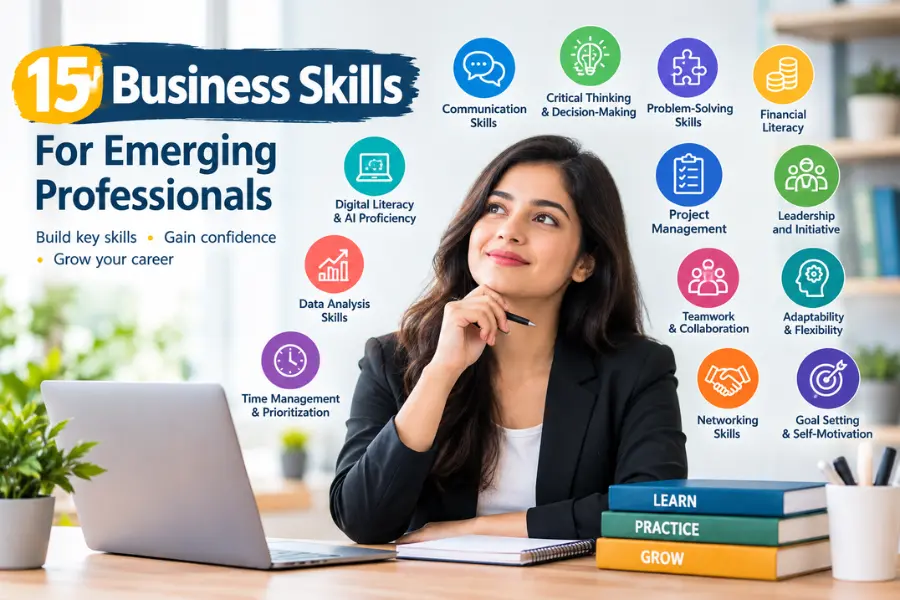
15 Business Skills For Emerging Professionals
Developing the right business skills can help emerging professionals become more effective, confident, and adaptable in the workplace. Although each skill’s importance varies by role and industry, certain abilities matter in almost every professional environment. The following skills can help you improve daily performance, work effectively with others, and prepare for long-term career growth.
1. Communication Skills
Communication skills help professionals share information, explain ideas, listen carefully, and build productive working relationships. Effective communication includes written, verbal, and nonverbal communication, as well as the ability to adjust your message to different audiences.
In the workplace, these skills are essential for writing professional emails, participating in meetings, presenting proposals, and explaining complex information clearly. Emerging professionals can improve communication by practising active listening, organizing their thoughts before speaking, and reviewing written messages for clarity and accuracy.
2. Critical Thinking and Decision-Making
Critical thinking involves examining information objectively, questioning assumptions, comparing alternatives, and reaching evidence-based conclusions. Decision-making builds on this ability by helping professionals select an appropriate course of action.
For example, when a marketing campaign produces disappointing results, a critical thinker reviews performance data, investigates possible causes, and evaluates potential improvements before recommending changes. Developing these business skills for emerging professionals can lead to better judgments, fewer avoidable mistakes, and more effective workplace decisions.
3. Problem-Solving Skills
Problem-solving enables professionals to identify challenges, understand their causes, and develop practical solutions. Instead of reacting immediately, effective problem-solvers gather relevant information, consider available resources, and evaluate the likely consequences of different approaches.
A project team experiencing repeated delays might review its workflow, identify communication gaps, and clarify responsibilities. Emerging professionals can strengthen this skill by breaking complicated problems into smaller tasks, asking useful questions, and reviewing the results of their solutions.
4. Financial Literacy
Financial literacy helps professionals understand budgets, expenses, revenue, profit, cash flow, and basic financial reports. Even employees who don’t work in finance can benefit from understanding how their decisions affect an organization’s financial performance.
For instance, comparing supplier prices, tracking departmental expenses, or estimating project costs can help a team use resources more efficiently. Beginners can develop financial literacy by learning basic accounting concepts, practising spreadsheet calculations, and studying simple business budgets.
5. Digital Literacy and AI Proficiency
Digital literacy involves using technology confidently, safely, and effectively to complete professional tasks. Depending on the role, it may include email platforms, spreadsheets, collaboration software, project management applications, data tools, and artificial intelligence systems.
Emerging professionals should learn how to use digital tools to organize information, automate repetitive tasks, and improve productivity. They should also understand data privacy, cybersecurity, and the importance of verifying AI-generated information before relying on it. These business skills are increasingly useful as workplaces adopt new technologies.
6. Data Analysis Skills
Data analysis helps professionals interpret information, recognize patterns, measure performance, and make informed recommendations. Basic analytical skills help in marketing, sales, finance, operations, human resources, and many other fields.
For example, an employee may compare monthly sales figures to identify top-performing products or review customer feedback to find recurring complaints. Beginners can practise using spreadsheets, creating simple charts, calculating percentages, and explaining what the results mean for a business.
7. Time Management and Prioritization
Time management involves planning work, allocating time appropriately, and meeting agreed deadlines. Prioritization helps professionals distinguish urgent tasks from activities that contribute most to important objectives.
A practical approach is to create a daily task list, divide larger assignments into manageable steps, and schedule focused periods for demanding work. Professionals should also account for unexpected requests and avoid committing to deadlines they cannot reasonably meet. Strong time management improves reliability, reduces unnecessary stress, and supports consistent performance.
8. Project Management
Project management involves organizing tasks, setting objectives, coordinating resources, monitoring progress, and completing work within agreed time and budget limits. These abilities are useful even for professionals who are not formal project managers.
For example, an employee coordinating a product launch may establish milestones, assign responsibilities, track expenses, and communicate progress to team members. Emerging professionals can practise these skills by managing academic projects, organizing workplace activities, or using project management tools to track tasks and deadlines.
9. Leadership and Initiative
Leadership is the ability to guide, motivate, support, and influence others toward a shared objective. It does not always require a management title. Employees can demonstrate leadership by taking responsibility, helping colleagues, proposing improvements, and following through on commitments.
Initiative is especially valuable for early-career professionals because it demonstrates a willingness to contribute beyond routine assignments. For example, an employee who notices a repeated workflow problem and suggests a practical improvement shows both initiative and problem-solving ability.
10. Teamwork and Collaboration
Teamwork involves sharing responsibilities, respecting different perspectives, exchanging information, and working toward common goals. Effective collaboration requires reliability, flexibility, constructive feedback, and a willingness to support colleagues when challenges arise.
For instance, in a cross-functional project, marketing, finance, and technical teams may need to coordinate their activities to meet a launch deadline. Emerging professionals can improve collaboration by clarifying expectations, communicating progress, respecting agreed responsibilities, and addressing disagreements professionally.
11. Negotiation and Conflict Resolution
Negotiation helps professionals reach mutually acceptable agreements about expectations, resources, deadlines, responsibilities, or business terms. Conflict resolution focuses on addressing disagreements constructively rather than allowing them to damage working relationships.
A professional negotiating a project deadline might explain the work required, discuss competing priorities, and propose a realistic alternative. Emerging professionals can develop these business skills by practising respectful discussion, identifying shared interests, listening to opposing viewpoints, and focusing on solutions rather than personal criticism.
12. Emotional Intelligence
Emotional intelligence is the ability to recognize and manage your own emotions while understanding how others may feel and respond. It supports self-awareness, empathy, communication, teamwork, and conflict management.
For example, when receiving critical feedback, an emotionally intelligent professional listens carefully, avoids an immediate defensive reaction, and considers how to improve. Professionals can strengthen this skill by reflecting on their reactions, asking for feedback, practising empathy, and responding thoughtfully in stressful situations.
13. Adaptability and Continuous Learning
Adaptability enables professionals to respond constructively to changing priorities, new responsibilities, evolving technologies, and unfamiliar challenges. Continuous learning helps them stay current and build new capabilities throughout their careers.
For instance, an employee may need to learn a new software platform after a company updates its workflow. Instead of resisting the change, an adaptable professional explores training resources, practises using the system, and asks questions when necessary. Staying curious and open to feedback helps emerging professionals remain prepared for changing workplace expectations.
14. Marketing, Sales, and Customer Awareness
Marketing and sales skills help professionals understand customer needs, communicate value, build relationships, and support business growth. Even people outside sales roles benefit from recognizing how their work affects customer satisfaction and organizational reputation.
For example, a customer support employee who identifies recurring complaints can share useful insights with the product team. An aspiring entrepreneur can use customer research to evaluate demand before investing in a new idea. These skills help professionals connect business activities with customer expectations and measurable outcomes.
15. Business Ethics and Professional Integrity
Business ethics involves making responsible decisions, treating people fairly, protecting confidential information, and following applicable laws and organizational policies. Professional integrity means being honest, dependable, and accountable for your actions.
For example, an employee handling customer information should follow privacy requirements and avoid sharing sensitive data without authorization. Similarly, professionals should report errors honestly, accurately acknowledge their contributions, and disclose potential conflicts of interest when appropriate. Ethical conduct builds trust and supports a healthy, sustainable business environment.
Mastering these business skills takes consistent practice, not an overnight effort. Start with the abilities most relevant to your career goals, apply them in real situations, and seek feedback to measure your progress. Over time, combining interpersonal strengths, practical business knowledge, and digital competence can help you become a more capable and valuable professional.
Technical Skills vs Soft Skills in Business
Both technical and soft skills matter for emerging professionals. Technical skills help individuals perform specific tasks using specialized knowledge and tools, while soft skills support communication, collaboration, leadership, and professional relationships. Understanding the difference between these skill categories helps beginners identify their strengths and recognize areas for improvement.
What Are Technical Skills?
Technical skills are practical abilities that professionals use to complete specific work-related tasks. They are often developed through formal education, training programs, certifications, and hands-on experience.
Examples of technical skills include:
- Spreadsheet management: Using formulas, functions, and charts to organize and analyze information.
- Data analysis: Interpreting figures, identifying trends, and preparing reports.
- Financial management: Understanding budgets, expenses, revenue, and basic financial statements.
- Digital tools: Using business software, collaboration platforms, and project management applications.
- Digital marketing: Working with search engine optimization, online advertising, analytics, and content management systems.
These abilities help professionals complete tasks accurately, improve efficiency, and contribute to business objectives. The technical skills you need will depend on your chosen industry and job responsibilities.
What Are Soft Skills?
Soft skills are interpersonal and personal abilities that influence how individuals communicate, manage responsibilities, and work with others. They matter across nearly every industry because professional success often depends on more than technical knowledge.
Important soft skills include:
- Communication: Expressing ideas clearly and listening actively.
- Teamwork: Cooperating with colleagues to achieve shared objectives.
- Leadership: Taking initiative and helping others work toward common goals.
- Problem-solving: Identifying challenges and evaluating practical solutions.
- Adaptability: Responding effectively to changes in responsibilities and workplace expectations.
- Emotional intelligence: Understanding emotions and managing professional interactions constructively.
Strong soft skills help emerging professionals build trust, handle disagreements, and maintain productive working relationships.
Key Differences Between Technical Skills and Soft Skills
| Comparison | Technical Skills | Soft Skills |
|---|---|---|
| Main purpose | Complete specialized tasks | Improve interactions and work habits |
| Examples | Data analysis, accounting, spreadsheets | Communication, teamwork, leadership |
| Development | Training, courses, and practical exercises | Practice, feedback, and workplace experience |
| Assessment | Tests, work samples, and task performance | Observed behavior, collaboration, and feedback |
| Workplace value | Improves task accuracy and efficiency | Strengthens relationships and teamwork |
Which Skills Should Emerging Professionals Prioritize?
The best approach is to develop both categories rather than choosing one over the other. Technical skills show you can perform job-specific tasks, while soft skills help you communicate your work, collaborate with colleagues, and respond to professional challenges.
For example, an employee may use spreadsheet software to analyze sales data, but they still need communication skills to explain the findings to a manager. Similarly, a project coordinator may understand project management software but still need leadership, negotiation, and problem-solving skills to keep a team working effectively.
To build a balanced foundation, identify the technical requirements of your target career and combine them with transferable abilities such as communication, critical thinking, and adaptability. This balanced approach to business skills for emerging professionals can improve job readiness, support workplace performance, and prepare you for greater responsibilities.
How to Develop Business Skills Without Work Experience
Emerging professionals can develop business skills without years of employment or a formal business degree. Students, recent graduates, career changers, and job seekers can build valuable skills through hands-on practice, self-study, volunteering, and collaborative projects. The key is to move beyond reading about business concepts and find opportunities to apply them in realistic situations.
1. Take Online Courses and Professional Training
Online courses can help beginners understand essential business concepts, including communication, financial literacy, project management, digital marketing, and data analysis. Choose courses that match your career interests and include practical assignments rather than relying exclusively on theory.
Look for learning resources from reputable universities, professional organizations, and established educational platforms. Completing a course shows initiative, but focus on the knowledge and practical skills you gain rather than collecting certificates without applying what you learn.
2. Practise Through Personal Projects
Personal projects let emerging professionals build business skills without waiting for their first job. Choose a manageable project that reflects the type of work you want to pursue.
For example, you could create a sample business plan, prepare a spreadsheet budget, analyze publicly available sales data, or develop a digital marketing strategy for a fictional company. Set a clear objective, establish a deadline, track your progress, and evaluate the final result.
These projects can also become work samples that demonstrate your abilities to potential employers.
3. Participate in Internships and Volunteering
Internships and volunteering provide opportunities to practise professional skills in real or realistic working environments. You may help organize an event, maintain records, coordinate a team, prepare reports, or support a nonprofit organization’s communication activities.
These experiences can improve your teamwork, time management, problem-solving, and organizational abilities. They also help you understand professional expectations, receive feedback, and learn how different responsibilities contribute to a larger objective.
When choosing an opportunity, prioritize meaningful responsibilities, appropriate supervision, and learning opportunities.
4. Improve Communication Through Regular Practice
Clear communication is one of the most transferable business skills for emerging professionals. You can develop it by writing professional emails, practising presentations, participating in discussions, and explaining complex ideas simply.
Before sending an email, check whether the purpose is clear, the tone is appropriate, and the requested action is easy to understand. When speaking, organize your main points and listen carefully to other people’s questions.
You can also ask a teacher, mentor, colleague, or trusted peer to review your communication and suggest specific improvements.
5. Learn Essential Digital and Analytical Tools
Digital proficiency can help beginners complete tasks efficiently and demonstrate practical competence. Start with tools relevant to your intended career, such as spreadsheets, word-processing software, presentation applications, project management platforms, or basic data visualization tools.
Practise using formulas, organizing information, creating charts, tracking tasks, and preparing simple reports. You can also explore AI tools for brainstorming or organizing information, but check their outputs for accuracy and protect confidential data.
Rather than trying to master every application, focus on a small set of tools that support your professional goals.
6. Find a Mentor and Request Feedback
A mentor can help you understand workplace expectations, identify skill gaps, and make informed professional development decisions. Mentors may include experienced professionals, instructors, supervisors, or people working in your desired industry.
Prepare specific questions about the skills employers value, common beginner mistakes, and ways to gain relevant experience. After completing a project or presentation, ask for feedback on what worked well and what could be improved.
Apply that feedback to your next task. This process helps turn experience into measurable improvement.
7. Build a Portfolio of Your Achievements
A professional portfolio can demonstrate your abilities when you have limited employment history. Include relevant projects, reports, presentations, case studies, certificates, and examples of work that you are authorized to share.
For each project, briefly explain the objective, your responsibilities, the tools you used, and the outcome. Where possible, include measurable results, such as completing a project before its deadline or identifying a potential cost-saving opportunity in a sample budget.
Never include confidential employer information or claim results you cannot verify. A clear, honest portfolio helps employers see how you apply your business skills in practical situations.
A Simple 30-Day Plan to Build Business Skills
Use the following plan to turn learning into consistent action.
| Period | Main focus | Practical activity |
|---|---|---|
| Week 1 | Communication and time management | Write professional emails and plan a weekly schedule |
| Week 2 | Financial and digital skills | Create a sample budget and practise spreadsheet formulas |
| Week 3 | Problem-solving and project management | Complete a small project with clear milestones |
| Week 4 | Teamwork and professional development | Request feedback, revise your work, and prepare a portfolio sample |
At the end of the month, review your progress and identify two or three skills that need further development. Repeat the process with more challenging tasks as your confidence grows.
Building business skills for emerging professionals is an ongoing process. By combining structured learning, hands-on practice, constructive feedback, and evidence of your achievements, you can develop practical capabilities even before securing your first full-time position.
Practical Examples of Business Skills in the Workplace
Understanding business skills for emerging professionals is easier when you see how they apply in everyday workplace situations. These skills are not limited to managers or business owners; employees at every career stage use them to complete tasks, support colleagues, solve problems, and contribute to organizational goals.
Example 1: Using Communication to Prevent Mistakes
Imagine an employee receives an assignment with unclear instructions and a tight deadline. Instead of making assumptions, the employee asks specific questions, confirms the expected outcome, and summarizes the agreed requirements in a professional email.
This approach demonstrates effective communication and active listening. It reduces misunderstandings, clarifies responsibilities, and makes it easier to complete the assignment correctly.
Example 2: Applying Financial Literacy to Control Costs
Suppose a team has a limited budget for a company event. An employee compares supplier quotations, estimates expenses, and tracks spending in a spreadsheet.
By using financial literacy and analytical skills, the employee can identify cost-effective options while maintaining the required quality. This example shows how understanding basic business finances can support better resource management, even when financial management is not part of the employee’s main job.
Example 3: Using Data Analysis to Improve Results
Consider a marketing assistant who notices that a company’s online campaign receives many visits but generates relatively few inquiries. The assistant reviews website traffic, conversion rates, and campaign performance to identify possible reasons.
The assistant then presents the findings and suggests testing a clearer call to action. This demonstrates data analysis, critical thinking, and decision-making. Rather than relying on assumptions, the employee uses evidence to recommend improvements.
Example 4: Demonstrating Leadership Through Initiative
A new team member notices that colleagues frequently miss internal deadlines because task responsibilities are unclear. The employee proposes a shared task tracker that lists assignments, owners, and due dates.
This initiative demonstrates leadership, project management, and problem-solving without requiring a formal management position. If the team adopts the system and reviews its effectiveness, the employee can also learn to measure improvements and adjust the process as needed.
Example 5: Applying Teamwork to Complete a Project
A cross-functional team is preparing to launch a new product. The marketing team needs product information, the finance team must review costs, and the technical team must confirm readiness.
An employee who communicates updates, respects other departments’ responsibilities, shares relevant information, and raises potential delays early helps the entire team coordinate its work. This demonstrates teamwork, adaptability, and collaboration.
Example 6: Using Emotional Intelligence to Resolve Conflict
Two colleagues disagree about how to complete an important assignment. Instead of responding defensively, an employee listens to both perspectives, identifies their shared objective, and helps compare the advantages of each proposed approach.
This situation demonstrates emotional intelligence, negotiation, and conflict resolution. By focusing on the issue rather than personal criticism, the employee helps maintain a professional relationship while working toward a practical solution.
How to Apply These Examples to Your Career
You can use these situations to identify opportunities to practise business skills in your own environment. During a class project, internship, volunteer activity, or entry-level job, look for tasks that require planning, communication, analysis, teamwork, or decision-making.
After completing a task, consider what you did, which skills you used, and what you could improve next time. Record meaningful achievements and measurable outcomes when possible. This reflection helps you recognize your progress and gives you specific examples to discuss in job interviews.
The most effective way to develop business skills is to apply them consistently. Small improvements in everyday tasks can build the practical experience, professional confidence, and judgment needed for greater responsibilities over time.
Common Business Skills Mistakes to Avoid
Developing business skills for emerging professionals requires consistent effort, practical experience, and a willingness to learn from mistakes. However, beginners sometimes focus on the wrong priorities or miss opportunities to apply what they learn. Recognizing these mistakes can help you build stronger professional skills and use your time more effectively.
1. Focusing Only on Technical Skills
Learning specialized software, spreadsheet formulas, or industry-specific tools can improve your job readiness, but technical knowledge alone may not be enough. Professionals also need communication, teamwork, critical thinking, and adaptability to work effectively with others.
How to avoid this mistake: Create a balanced learning plan that includes both technical and interpersonal skills. For every technical course you complete, look for an opportunity to practise explaining your work, collaborating with others, or solving a practical problem.
2. Learning Theory Without Practical Application
Reading books, watching tutorials, and completing online courses can build foundational knowledge. However, these activities may not prepare you fully for workplace challenges if you never apply what you learn.
How to avoid this mistake: Practise through personal projects, internships, volunteering, case studies, or realistic business exercises. For example, after learning about budgeting, create a sample project budget and explain how you would control costs.
3. Ignoring Feedback and Self-Improvement
Some beginners avoid feedback because they fear criticism or see mistakes as signs of failure. This attitude can prevent them from identifying weaknesses and improving their performance.
How to avoid this mistake: Ask specific questions about your work, listen without becoming defensive, and choose one or two areas to improve. Review your progress regularly and apply the lessons to future assignments.
4. Trying to Master Every Skill at Once
Trying to learn communication, leadership, finance, marketing, coding, and several digital tools at once can create unnecessary pressure and make progress hard to measure.
How to avoid this mistake: Prioritize the business skills most relevant to your career goals. Start with essential transferable abilities, then add specialized skills as your responsibilities and interests develop.
5. Neglecting Professional Communication
Even capable employees can create misunderstandings by sending unclear emails, missing important updates, interrupting colleagues, or failing to confirm expectations. Poor communication can affect teamwork, deadlines, and professional relationships.
How to avoid this mistake: Practise active listening, keep messages focused on their main purpose, confirm key instructions, and communicate delays as early as possible. Use a respectful, clear tone in meetings, emails, and workplace discussions.
6. Overlooking Financial and Data Literacy
Some professionals assume budgets, spreadsheets, and performance metrics matter only to finance or data-related roles. In reality, many roles require employees to understand costs, interpret information, or evaluate results.
How to avoid this mistake: Learn basic financial concepts, practise spreadsheet calculations, and become comfortable interpreting simple charts and reports. Understanding these fundamentals can help you make more informed recommendations and recognize the business impact of your work.
7. Relying on Artificial Intelligence Without Verification
AI tools can assist with research, writing, brainstorming, and routine tasks, but their outputs may contain errors, outdated information, or misleading conclusions. Sharing confidential information with unsuitable tools can also create privacy and security risks.
How to avoid this mistake: Treat AI as a support tool, not a replacement for professional judgment. Verify important claims using reliable sources, review generated content carefully, and follow workplace policies for data protection and approved technology use.
8. Failing to Demonstrate Your Skills
Developing business skills for emerging professionals is valuable, but employers may struggle to assess your abilities if you can’t show examples of how you have used them. Simply listing communication, leadership, or problem-solving on a résumé may not demonstrate your actual competence.
How to avoid this mistake: Keep a record of relevant projects, responsibilities, feedback, and measurable achievements. Prepare concise examples explaining the challenge you faced, the action you took, and the result. Use honest, specific evidence in your résumé, portfolio, and interviews.
9. Avoiding Challenges and New Responsibilities
Sticking only to familiar tasks may feel comfortable, but it can limit opportunities to practise new skills. Emerging professionals often learn valuable lessons by taking on manageable challenges and working through unfamiliar problems.
To avoid this mistake, volunteer for appropriate assignments, contribute ideas during team discussions, and take responsibility for achievable projects. Ask for guidance when needed and treat setbacks as opportunities to identify what should change next time.
10. Treating Skill Development as a One-Time Activity
Business practices, workplace technologies, customer expectations, and industry requirements keep evolving. Skills that are useful today may need updating as job responsibilities change.
To avoid this mistake, make continuous learning part of your professional routine. Review job descriptions in your field, identify emerging requirements, seek relevant training, and periodically evaluate your progress. Focus on skills with practical value rather than chasing every new trend.
Avoiding these common mistakes can make your development more focused and productive. By combining practical experience with constructive feedback, balanced learning, and consistent reflection, you can strengthen your business skills as an emerging professional and prepare for increasingly complex workplace responsibilities.
How Business Skills Support Career Growth
Developing business skills for emerging professionals can support career advancement by improving workplace performance, strengthening professional relationships, and preparing individuals for greater responsibilities. Employers often value people who can combine job-specific knowledge with communication, problem-solving, teamwork, and sound decision-making. These abilities can help professionals contribute more effectively as their careers progress.
1. Improving Job Performance and Productivity
Strong business skills help employees organize their work, communicate expectations, manage deadlines, and solve problems efficiently. For example, a professional who uses time management and project planning techniques can coordinate assignments more effectively and reduce avoidable delays.
Consistently completing work accurately and meeting agreed expectations can build trust with supervisors and colleagues. Over time, reliable performance may create opportunities to take on more complex assignments and demonstrate readiness for advancement.
2. Increasing Employability and Job Opportunities
Employers seek candidates who can perform a role’s responsibilities and adapt to their organization’s needs. Communication, digital literacy, analytical thinking, and collaboration can strengthen a candidate’s profile across many industries.
Emerging professionals can demonstrate these abilities through relevant coursework, internships, practical projects, volunteer activities, and a portfolio of completed work. Providing specific examples of how you solved a problem or contributed to a project can make your application more convincing than simply listing skills on a résumé.
3. Preparing for Leadership and Management Roles
Leadership opportunities often require more than technical expertise. Professionals may need to coordinate colleagues, allocate resources, resolve disagreements, evaluate performance, and communicate organizational priorities.
Developing business skills for emerging professionals, such as delegation, negotiation, emotional intelligence, and project management, can help prepare them for these responsibilities. Beginners can start by coordinating small projects, mentoring peers when appropriate, or volunteering to organize team activities.
These experiences provide opportunities to practise leadership before moving into a formal supervisory position.
4. Supporting Salary Negotiations and Professional Recognition
Professionals who understand their contributions and communicate them effectively may be better prepared to discuss compensation, promotions, and new responsibilities. Financial literacy can also help them understand compensation packages, benefits, and the broader value of employment opportunities.
Before a salary discussion, research relevant market rates, review your responsibilities, and prepare evidence of your contributions. Examples include completing a project successfully, improving a process, supporting customer satisfaction, or reducing unnecessary expenses.
Although strong skills do not guarantee a higher salary, demonstrable achievements and effective negotiation can support informed career decisions.
5. Building Professional Networks and Relationships
Professional relationships can help individuals exchange knowledge, discover opportunities, receive guidance, and learn about their industries. Effective networking depends on clear communication, genuine interest, reliability, and respect for other people’s time.
Emerging professionals can build relationships by attending industry events, joining professional communities, contacting experienced individuals with thoughtful questions, and following up appropriately.
A strong professional network should focus on meaningful connections and mutual learning rather than collecting contacts solely for personal advantage.
6. Creating Opportunities for Entrepreneurship
Business skills matter not only for employees but also for people who want to start their own ventures. Financial literacy helps entrepreneurs estimate costs and manage cash flow, while marketing and sales skills help them understand customers and communicate the value of their offerings.
Problem-solving, adaptability, and decision-making can also help business owners respond to competition and changing customer needs. Before investing significant resources, aspiring entrepreneurs can practise by researching a target market, preparing a basic business plan, and testing demand for a product or service.
These skills provide a strong foundation for evaluating business opportunities and managing risk.
7. Staying Competitive in a Changing Job Market
Workplaces continue to evolve as organizations adopt new technologies, adjust business models, and respond to changing customer expectations. Professionals who stay willing to learn can adapt more effectively to new tools, responsibilities, and ways of working.
Continuous learning may involve improving digital skills, developing industry knowledge, studying new regulations, or strengthening analytical abilities. Regularly review job requirements in your chosen field to identify which skills need attention.
The most effective approach combines continuous learning with practical application so new knowledge translates into better workplace performance.
How to Turn Business Skills Into Career Progress
To make your development meaningful, connect each skill to a specific professional goal. If you want to improve employability, build relevant work samples. If you want to prepare for leadership, practise coordinating projects and supporting colleagues. If you want to pursue entrepreneurship, strengthen financial planning, customer research, and sales skills.
Review your progress regularly, seek feedback, and keep evidence of your achievements. By developing business skills for emerging professionals in a focused and practical way, you can improve your readiness for new opportunities and build a stronger foundation for long-term career growth.
FAQs
Understanding business skills for emerging professionals helps beginners identify the abilities they need to succeed in today’s workplace. The following frequently asked questions explain which skills to prioritize, how to develop them, and how to demonstrate them to potential employers.
The most important business skills for emerging professionals include:
- Communication: Sharing information clearly and listening effectively.
- Critical thinking: Evaluating information before making decisions.
- Problem-solving: Identifying challenges and developing practical solutions.
- Time management: Prioritizing tasks and meeting deadlines.
- Teamwork: Collaborating effectively with colleagues.
- Financial literacy: Understanding budgets, expenses, and basic financial concepts.
- Digital proficiency: Using workplace technology effectively.
The best starting point depends on your career goals and your target role’s requirements.
Yes. You can develop business skills for emerging professionals through several practical learning opportunities:
- Online courses and professional training.
- Personal projects and business case studies.
- Internships and volunteering.
- Group assignments and presentations.
- Self-study and regular practice.
- Feedback from mentors and experienced professionals.
A business degree may be required for certain positions, but you can develop many transferable business skills independently.
Several business skills for emerging professionals are valuable across a wide range of industries:
- Communication: Explaining ideas and sharing updates.
- Teamwork: Working toward shared objectives.
- Adaptability: Responding to changing responsibilities.
- Problem-solving: Handling workplace challenges.
- Critical thinking: Making informed decisions.
- Time management: Organizing tasks efficiently.
- Digital literacy: Using technology safely and effectively.
These abilities support professional performance in fields such as healthcare, technology, education, finance, marketing, and entrepreneurship.
You can demonstrate your business skills for emerging professionals by describing specific achievements and practical experiences:
- Include relevant projects, internships, and volunteer activities.
- Explain your responsibilities and individual contributions.
- Highlight examples of teamwork, leadership, and problem-solving.
- Include measurable results when they are available and verifiable.
- Mention relevant software, tools, and professional training.
- Prepare examples you can explain during job interviews.
For example, instead of simply writing “project management,” describe how you organized a group project, assigned responsibilities, and helped the team meet its deadline.
The time required depends on your skill, existing knowledge, and practice.
- Basic digital skills: You may learn common software functions within a few weeks.
- Communication skills: Regular practice in writing, speaking, and listening can improve gradually.
- Financial literacy: Basic budgeting and spreadsheet concepts can be learned through structured exercises.
- Leadership and negotiation: These often require repeated practice and experience with different situations.
- Strategic thinking: This develops through analysis, decision-making, feedback, and exposure to complex problems.
Set realistic goals, practise consistently, and review your progress to identify areas for improvement.
Business skills and technical skills serve different but complementary purposes.
- Business skills: Include communication, leadership, teamwork, financial understanding, and decision-making.
- Technical skills: Include specialized abilities such as programming, accounting software, spreadsheet analysis, and industry-specific tools.
- Practical application: Business skills help you collaborate and make decisions, while technical skills help you perform specialized tasks.
- Career development: Combining both categories can improve your ability to perform effectively and adapt to workplace demands.
The right balance depends on your profession, responsibilities, and long-term career goals.
Students can develop business skills for emerging professionals through activities that provide practical experience:
- Participate in group assignments to build teamwork skills.
- Deliver presentations to strengthen communication.
- Join student organizations to practise leadership.
- Volunteer to organize events and manage deadlines.
- Complete personal projects involving budgets or data analysis.
- Pursue internships to understand workplace expectations.
- Ask instructors, supervisors, and peers for feedback.
These activities can also provide relevant examples for résumés and job interviews.
Start with digital skills that match your intended career and common workplace requirements.
- Word processing: Create professional documents and reports.
- Spreadsheets: Organize information, use formulas, and prepare charts.
- Professional email: Communicate clearly and appropriately.
- Presentation software: Explain ideas through structured presentations.
- Collaboration tools: Share files, coordinate tasks, and communicate with teams.
- Data analysis: Interpret basic metrics and identify trends.
- AI proficiency: Use AI tools responsibly, verify outputs, and protect confidential information.
Focus on tools you can apply in realistic work situations rather than trying to master every available application.
Strong business skills for emerging professionals can support career growth in several ways:
- Improve the quality and efficiency of your work.
- Strengthen professional relationships and teamwork.
- Help you manage projects and solve complex problems.
- Prepare you for leadership and supervisory responsibilities.
- Support job applications with practical evidence of competence.
- Help you communicate achievements during performance reviews and salary discussions.
These skills can improve your readiness for new opportunities, although advancement also depends on experience, qualifications, performance, and available positions.
A structured approach can make professional development more manageable and effective.
- Identify priorities: Select skills that match your career objectives.
- Set clear goals: Define what you want to accomplish and by when.
- Practise regularly: Apply each skill through projects, assignments, or workplace tasks.
- Seek feedback: Ask trusted people to identify your strengths and weaknesses.
- Measure progress: Record completed projects and improvements.
- Update your knowledge: Explore relevant courses, tools, and industry developments.
- Review your plan: Adjust your priorities as your experience and responsibilities grow.
Consistent practice and real-world application can help you strengthen your business skills throughout your career as an emerging professional.
By continuously developing business skills, you can improve your workplace performance, build confidence, and prepare for new career opportunities. Start with practical goals, apply your knowledge consistently, and keep learning to support long-term professional growth.
Conclusion
Developing business skills for emerging professionals is an important step toward building a successful and sustainable career. Skills such as communication, critical thinking, financial literacy, digital proficiency, teamwork, and leadership can help individuals perform effectively, solve workplace challenges, and prepare for new responsibilities.
To strengthen these abilities, focus on practical actions:
- Identify your skill gaps and prioritize the abilities most relevant to your career goals.
- Practise consistently through personal projects, internships, volunteering, and workplace assignments.
- Seek constructive feedback to recognize weaknesses and improve your performance.
- Build a portfolio that demonstrates your achievements and practical experience.
- Continue learning as business practices, technologies, and professional expectations evolve.
Remember, mastering business skills as an emerging professional takes time, patience, and consistent effort. Start with a few essential skills, apply what you learn in real situations, and gradually expand your abilities. By combining practical knowledge with a willingness to improve, you can build professional confidence, increase your readiness for career opportunities, and lay a solid foundation for long-term growth.






- Be Respectful
- Stay Relevant
- Stay Positive
- True Feedback
- Encourage Discussion
- Avoid Spamming
- No Fake News
- Don't Copy-Paste
- No Personal Attacks
- Be Respectful
- Stay Relevant
- Stay Positive
- True Feedback
- Encourage Discussion
- Avoid Spamming
- No Fake News
- Don't Copy-Paste
- No Personal Attacks
